You’ll want an advanced filtration system combining mechanical, biological, and UV components to manage large koi ponds effectively. Gravity-fed setups reduce energy use and support natural flow, while pressurized canisters offer flexible installation with built-in UV clarifiers. Hybrid models integrate multiple stages for high fish loads, and bead filters provide efficient polishing. Using specialized media like K+ enhances bacterial colonization and algae control. Exploring system design and maintenance strategies further optimizes water quality and fish health.
Key Facts Summarized
- Multi-stage filtration combining mechanical, biological, and UV sterilization optimizes water clarity and pathogen control in large koi ponds.
- Gravity-fed systems reduce energy use by leveraging natural water flow through mechanical and biological media for effective filtration.
- Bead filters and drum filters automate waste removal and provide high-capacity mechanical-biological filtration for ponds up to 10,000 gallons.
- Food-grade, corrosion-resistant materials like polypropylene and 316 stainless steel ensure safe, durable media supporting beneficial bacterial colonization.
- Pre-filters, vortex chambers, and settlement tanks prevent clogging by efficiently removing sediments and suspended solids before biological filtration stages.
Overview of Filtration Systems for Large Koi Ponds

How can you ensure optimal water quality in a large koi pond? Start by implementing a multi-stage filtration system combining mechanical, biological, and UV sterilization components.
Mechanical filters with 200-300 micron sponges or screens capture debris, while biological filters provide extensive surface area for nitrifying bacteria to convert ammonia and nitrites into less harmful nitrates. Maintaining water quality management is crucial for preventing stress and health issues in koi.
UV sterilizers disrupt pathogens and control algae effectively. For ponds over 3,000 gallons, modular systems separate these stages for enhanced performance. Many of these systems, including Bio Reactor 10000 Filters, are designed specifically for high-capacity filtration needs.
Maintain a flow rate circulating the pond volume 4-6 times per hour using high-quality, variable-speed pumps to ensure consistent filtration efficiency. Regular maintenance—weekly mechanical cleaning, periodic biological servicing, and annual UV bulb replacement—preserves system efficacy.
Integrating multiple filtration types maximizes water clarity and koi health in large pond environments.
Gravity-Fed Filtration Systems: How They Work
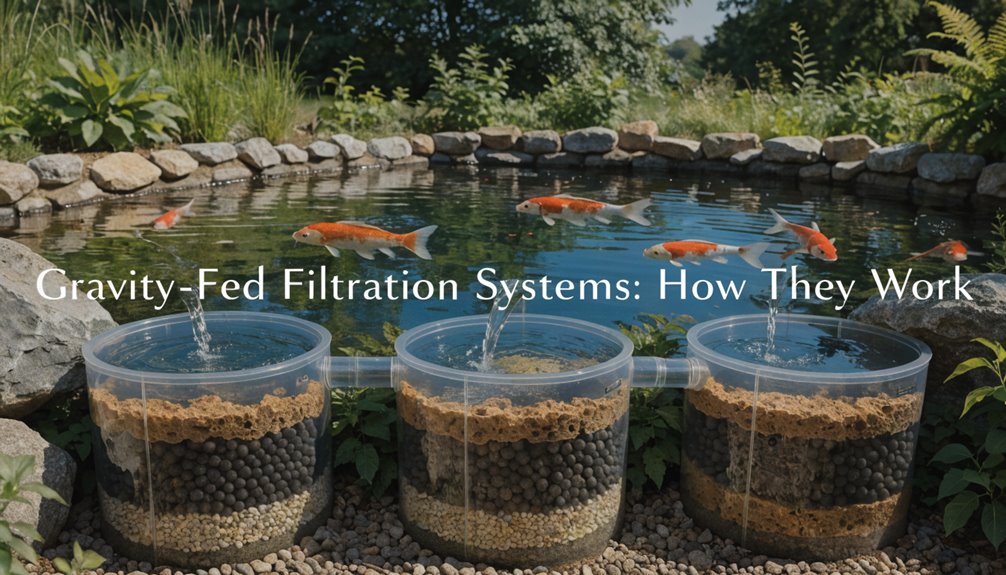
When you rely on gravity-fed filtration systems for large koi ponds, water moves naturally from the pond to the filter without requiring a pump for initial stages. Water flows from a higher elevation—usually via a bottom drain or surface skimmer—down through multiple filter media chambers. This natural flow also helps to prevent stagnant zones within the pond, maintaining oxygen levels essential for koi health. Additionally, proper pond construction is crucial to ensure effective water movement and filtration.
This gravity-driven flow allows mechanical filtration to remove larger debris first, followed by biological filtration where beneficial bacteria break down harmful nitrogen compounds.
The return pump only activates after these stages to send clean water back to the pond.
Key operational features include:
- Pre-filter screens capture large debris to prevent clogging
- Sequential media layers provide mechanical and biological filtration
System placement requires the filter tank to sit at or below pond level for proper flow.
This design reduces energy consumption and enhances filtration efficiency.
Pressurized Canister Filters and Built-In UV Clarifiers

You’ll appreciate their installation flexibility and sealed housing, which prevents debris escape and reduces maintenance frequency. However, these filters have limited media volume, restricting capacity for high-bioload koi ponds and necessitating supplemental pre-filtration. Pond filters that combine mechanical and biological filtration, such as those utilizing BioBalls for increased surface area, offer enhanced biological filtration performance.
Integrating built-in UV clarifiers enhances performance by disrupting algal reproduction, rapidly improving water clarity. UV effectiveness relies on contact time and light intensity, which demands regular bulb replacement. Monitoring ammonia levels is crucial to avoid toxicity in your koi pond.
When selecting a pressurized system, it is important to match turnover rates to pond volume and bioload, ensuring optimal filtration without compromise. Models like OASE Filtoclear demonstrate this balance effectively for medium-sized setups.
Hybrid Filtration Systems for Large Koi Ponds
Pressurized canister filters with built-in UV clarifiers offer compact, efficient filtration for medium-sized koi ponds. However, large ponds with heavy bioloads require more robust solutions. Understanding filtration needs guides component selection and overall pond health. Koi fish, or Nishikigoi, thrive in well-maintained water conditions, making effective filtration essential.
Hybrid filtration systems combine gravity-fed mechanical filtration with pressurized biological and UV components downstream, delivering scalable water quality management. You benefit from modular designs that accommodate complex plumbing and heavy fish loads, ensuring consistent turnover and toxin removal.
Key advantages include:
- Reduced clogging via settlement chambers or vortex pre-filters
- Flexible flow configurations for waterfalls and return points
- Enhanced biological filtration through multiple media chambers
Installation demands precise flow rate calculations and space for gravity-fed chambers. Maintenance is simplified by accessible filter chambers and infrequent cleaning, ensuring stable, crystal-clear water critical for koi health. Regular upkeep preserves water quality and extends equipment lifespan.
Bead Filters: Enhancing Mechanical Filtration Efficiency
Because bead filters combine mechanical and biological filtration within a compact, pressurized unit, they significantly enhance water clarity and quality in large koi ponds. You benefit from finely graded plastic or foam beads that create a dense matrix, capturing suspended solids down to very small particle sizes and reducing turbidity effectively. The filter is designed for ponds up to 10,000 gallons, ensuring suitability for large aquatic environments.
The compacted bead bed acts like a polishing stage, improving mechanical filtration beyond conventional media. Simultaneously, the extensive bead surface supports colonization of nitrifying bacteria, integrating biological filtration within the same unit. Proper hydraulic loading and oxygenation are critical to maintain aerobic biofilm without excessive loss during backwashing. Accurate pond volume measurement is essential for optimizing the performance of these filters, ensuring that treatment dosages are correctly calibrated.
Advanced designs use water-only jets for efficient bead bed scouring, minimizing dead zones and operational costs, thus optimizing filtration performance for high-volume koi pond systems.
Drum Filtration Systems for High-Volume Koi Ponds
When managing high-volume koi ponds, drum filtration systems offer a robust solution by automatically removing solid waste through a rotating mesh drum.
As water flows through the fine mesh, particles as small as 50–70 µm are trapped and flushed without interrupting filtration. This continuous operation reduces organic load and eases downstream biological filtration. Ensuring high flow rate capabilities is essential for maintaining effective filtration in large-scale systems.
You’ll appreciate these key advantages:
- Automated self-cleaning cycles minimize labor and maintain consistent water flow.
- Scalability allows integration into ponds handling up to 30,000 gallons per hour.
- Modular designs support combination with biological or chemical filtration stages.
Why Food-Grade Materials Matter in Koi Pond Filters
Drum filtration systems handle large volumes of water efficiently, but their effectiveness depends heavily on the materials used within the filter components. Using food-grade materials ensures chemical stability, preventing toxic leaching of BPA, phthalates, or heavy metals that could harm your koi.
These materials comply with rigorous FDA testing, maintaining integrity despite temperature fluctuations common in pond environments. Polypropylene bristles and food-grade ceramic media optimize beneficial bacterial colonization, crucial for biological filtration. The use of a fine mesh filter material can further enhance water clarity by capturing small particles and supporting biological filtration.
Their inert nature supports robust biofilm development without antimicrobial interference, enhancing filtration efficiency. Additionally, food-grade filter pads resist degradation through repeated rinsing, extending lifespan and reducing maintenance costs.
Most importantly, these materials protect koi health by avoiding bioaccumulative toxins, supporting respiration, scale integrity, and osmoregulation. Choosing food-grade components is fundamental to sustaining long-term water quality and fish welfare in large koi pond filtration systems.
Using 316 Stainless Steel Media to Capture Fine Particles
Though capturing fine particles poses significant challenges in koi pond filtration, using 316 stainless steel mesh offers a precise and durable solution. Its ultra-fine 0.263mm hole size efficiently traps microscopic debris without compromising hydraulic flow. The 0.16mm wire thickness ensures structural integrity under continuous filtration cycles. The premium 316 grade resists corrosion, maintaining dimensional stability and preventing harmful leachates in aquatic environments. Available in various sheet sizes including A4 and A2, this mesh can be tailored to fit different filtration system designs.
When you integrate this media, consider:
- Optimized 60 LPI mesh configuration for maximal surface area and filtration efficiency
- Non-reactive, smooth surface reducing biofilm adhesion and maintenance demands
- Compatibility with multi-stage filtration setups for progressive fine particle removal
This approach balances fine particulate capture with operational durability, ensuring crystal-clear koi pond water.
The Role of Pre-Filters in Protecting Biological Filters
Because biological filters rely on unobstructed media surfaces to support beneficial bacteria, pre-filters play a critical role in intercepting suspended solids before they reach these chambers. By capturing particles as small as 5 microns, pre-filters prevent sediment accumulation that would clog biological media, reducing oxygen flow and bacterial efficiency.
They also remove microorganisms and organic contaminants down to 1 micron, limiting bio-fouling and protecting nitrifying bacteria from pathogenic competition and chemical damage. This pre-filtration ensures consistent water flow and nutrient delivery throughout the biological filter, preventing anaerobic dead zones. Additionally, prefiltration reduces energy costs by preventing increased pressure caused by membrane fouling, which helps maintain system efficiency and longevity reduces energy costs.
Consequently, you’ll extend the lifespan of biological filter media, reduce maintenance frequency, and lower operational costs. In large koi pond systems, integrating effective pre-filters is essential for maintaining optimal biological filtration performance and system longevity.
Settlement Chambers and Vortex Pre-Filters Explained
When water enters vortex settlement chambers at high velocity, the rotational flow it generates forces suspended solids to separate efficiently from the water column. This rotational movement creates centrifugal force, causing debris and heavier particles to settle at the chamber’s base.
The extended water path inside vortex chambers enhances residence time compared to straight-line tanks, improving sedimentation. Vertical slot inlet manifolds form thin water films near walls, increasing separation efficiency, while friction slows boundary layers, aiding settling. The recommended size for a vortex chamber is approximately 10% of the flow rate, ensuring sufficient dwell time for solids to settle effectively.
Key operational aspects include:
- Multi-chamber systems progressively remove debris, from large particles in primary chambers to finer solids in subsequent ones.
- Accumulated waste collects centrally, enabling rapid flushing via waste valves.
- Flow rates must remain below 3,500 GPH per chamber to maintain effective settling dynamics.
These features make vortex pre-filters essential for efficient koi pond filtration.
Matching Filtration Capacity to Pond Size and Fish Load
Vortex settlement chambers efficiently remove suspended solids, but sizing your filtration system correctly depends on the pond’s volume and fish load.
Calculate pond volume precisely using the appropriate formula—rectangular (length × width × depth × 7.5), circular (diameter² × depth × 5.9), or oval (length × width × depth × 6.7)—after converting measurements to feet.
Mechanical filters should process at least 1× the pond volume per hour, ideally 1.5× for optimal clarity.
For biological filtration, base capacity on fish load: koi require 35 gallons per inch of fish length, goldfish 20 gallons.
Calculate total fish length, then ensure filter capacity and pond surface area meet oxygenation needs.
Over-filtering minimally impacts performance and benefits heavily stocked ponds.
Matching filtration to these parameters ensures effective waste removal and water quality maintenance.
Designing Plumbing and Flow Rates for Optimal Filtration
How do you ensure your koi pond’s plumbing supports optimal filtration performance? Start by sizing pipes correctly: use a minimum 1.5″ diameter for pump suction and pressurized lines, and at least 2″ for gravity-fed returns, stepping up to 3″ for longer runs.
Next, calculate flow rates precisely—aim to cycle your pond volume 1-2 times per hour, adjusting for pond size and filtration efficiency. For pumped systems, position the pump at least 12” above the pond base to prevent sediment intake and ensure pump longevity (pump positioning).
Finally, minimize friction losses through strategic pipe layout and valve placement.
- Use swept bends and short pipe runs to reduce head pressure
- Install isolation valves before and after filters for easy maintenance
- Employ fractal plumbing with multi-return manifolds to ensure balanced flow
This approach guarantees efficient water movement, reduces pump strain, and maintains optimal filtration efficacy.
When to Choose Hybrid Low-Headroom Systems
Although traditional filtration setups work well for many koi ponds, you’ll find hybrid low-headroom systems offer distinct advantages for large or densely stocked water gardens. These systems integrate gravity-fed mechanical filtration upstream with pressurized bio and UV filtration downstream, optimizing water quality while maintaining a compact footprint.
If your pond demands high-volume filtration with minimal space, hybrid low-headroom models excel due to their customizable capacity and retrofit flexibility. They accommodate heavy organic loads, support automated backwash cycles, and simplify maintenance with larger accessible chambers.
Their pressurized flow enables uphill water return, making installation adaptable to space constraints. Additionally, these systems often feature heavy-duty tanks that enhance durability and filtration efficiency. Choose hybrid low-headroom systems when upgrading existing setups or managing dense koi populations needing robust, efficient filtration without expansive headroom requirements.
Multi-Filter Setups: Building Redundancy for Large Ponds
Hybrid low-headroom systems efficiently manage space and flow dynamics, but large koi ponds often demand additional layers of filtration security to maintain water quality under heavy biological loads. You can build redundancy by employing multi-chambered filter setups that isolate maintenance to individual sections, preventing disruption of the entire system and preserving bacterial colonies in untouched chambers. This design stabilizes biological conversion and extends maintenance intervals. Regular upkeep and proactive management are crucial to preserving water quality and extending equipment lifespan.
Key advantages of multi-filter setups include:
- Sequential mechanical filtration stages that remove heavy sediment before biological chambers, protecting bio-media from clogging.
- Gravity-fed pump placement at the system’s end to prevent solids damage and enable continuous circulation via redundant pumps.
- Multi-bay configurations allowing scalable processing capacities, essential for ponds exceeding 4,000 gallons.
Implementing these design principles ensures robust, efficient filtration tailored for large koi pond ecosystems.
How K+ Advanced Media Improves Biological Filtration
When you select filtration media for large koi ponds, K+ Advanced Media stands out by significantly enhancing biological filtration efficiency through its superior surface area and innovative design. Its class-leading 1,350m²/m³ total surface area and 1,025m²/m³ protected zones foster stable biofilm crucial for nitrifying bacteria. Mineral and enzyme integration during extrusion accelerates filter maturation, reducing ammonia spikes and preserving beneficial bacteria during cleaning. The K+ media’s ability to prevent bacteria loss during maintenance ensures consistent biological filtration without causing harmful ammonia or nitrite spikes.
| Feature | Specification | Benefit |
|---|---|---|
| Surface Area | 1,350m²/m³ total, 1,025m² protected | Maximizes bacterial colonization |
| Design | Quiet zones, fins, extrusion | Supports robust biofilm stability |
| Mineral/Enzyme Content | Magnesium, calcium, enzymes | Speeds biofilm formation, improves adhesion |
| Filtration Efficiency | Enhanced solids removal | Maintains clear water with less pump strain |
Controlling Algae With Biological Chambers in Koi Ponds
How do biological chambers effectively control algae growth in large koi ponds? They create an optimized environment for beneficial bacteria to thrive, which outcompete algae by depleting essential nutrients like nitrogen and phosphorus.
This bacterial competition reduces nutrient availability, slowing algae proliferation and preventing oxygen depletion.
To maximize algae control, focus on:
- Expanding surface area with bio partitioning and layered media stacking to enhance bacterial colonization
- Maintaining optimal water circulation rates (minimum once every two hours) to ensure uniform nutrient processing and prevent stagnation
- Applying regular bacterial inoculants to sustain robust populations that decompose organic waste efficiently
Maintaining Gravity-Fed vs. Pressurized Filters
Although both gravity-fed and pressurized filters serve essential roles in koi pond management, their maintenance demands differ significantly due to design and operational characteristics.
Gravity-fed filters require weekly cleaning for heavy fish loads, benefiting from gentle waste flow that reduces clogging and extends intervals, especially with settlement chambers. You’ll need to monitor silt accumulation in lower chambers due to below-water placement but will find accessible chambers simplify upkeep.
In contrast, pressurized filters rely on backwash systems to reduce manual cleaning intensity, but pump-driven waste blending demands more frequent clogging assessments. Their sealed design limits debris ingress, shortening routine maintenance time.
When maintaining, remember to size pressurized filters at half the manufacturer’s rating for accurate planning. Your choice depends on balancing maintenance frequency, operational efficiency, and installation constraints.
Frequently Asked Questions
How Often Should UV Clarifiers Be Replaced in Pressurized Canister Filters?
You should replace UV clarifier lamps annually to maintain peak UVC output at 253 nm, ensuring effective bacterial and algal elimination. Regular replacement prevents efficiency decline and aligns with manufacturers’ recommended maintenance schedules.
What Are the Signs of Filter Media Needing Replacement or Regeneration?
When your filter media shows worn edges, holes, or tears, it’s time for replacement. If water flow weakens, pressure spikes, or water remains cloudy despite cleaning, regeneration or replacement is crucial to restore optimal filtration performance.
Can Filtration Systems Be Powered by Solar Energy for Eco-Friendly Operation?
Yes, you can power filtration systems with solar energy. Solar panels efficiently supply DC power to pumps, reducing grid dependency and operational costs, while hybrid setups ensure continuous filtration by seamlessly switching between solar and grid power.
How Do Seasonal Temperature Changes Affect Filtration Efficiency and Maintenance?
You’ll notice filtration efficiency dances with seasonal shifts: cold slows bacteria, spring stirs pathogens, summer strains oxygen and bio-filters, while fall demands sludge control and aeration. Maintenance must adapt precisely to these dynamic thermal challenges.
Are There Specific Filter Setups Recommended for Newly Stocked Koi Ponds?
You should use multi-chamber filters separating mechanical and biological stages, with graded filter mats to trap debris. Regularly dose beneficial bacteria to accelerate cycling, ensuring mature colonies before stocking heavily for optimal ammonia and nitrite conversion.
Conclusion
You’ve navigated the intricate currents of advanced koi pond filtration, and now you hold the blueprint for pristine waters. Like a well-tuned engine, integrating gravity-fed systems, pressurized filters, and K+ media sharpens your pond’s health. Embrace hybrid and multi-filter setups to build resilient defenses against algae and waste. By mastering maintenance nuances, you’ll keep your koi’s environment crystal clear—a symphony of mechanical and biological precision that sustains vibrant aquatic life.