If you want the world’s finest koi, Japan’s Niigata Prefecture is where you’ll find legendary farms like Dainichi and Sakai, renowned for superior genetics and meticulous breeding techniques. These farms combine mineral-rich waters, multi-generational expertise, and advanced quality controls to produce prized Nishikigoi. Prices can reach six figures due to rarity and craftsmanship. Visiting these farms reveals their unique environments and breeding philosophies, offering deep insights into why Niigata koi remain unmatched globally.
Key Facts Summarized
- Dainichi Koi Farm in Niigata is renowned for jumbo Kohaku and Sanke, winning numerous Grand Champion titles globally.
- Shinoda Koi Farm specializes in Hi Utsuri with vibrant coloration and rapid growth, established in 1952 in Niigata.
- Sekiguchi Koi Farm focuses on the “Sekiguchi Showa” strain, excelling in patterning and skin quality for Showa varieties.
- Sakai Koi Farm boasts over 120 years of tradition, excelling in Gosanke breeds with superior body structure and stable white backgrounds.
- Ogata Koi Farm operates advanced facilities with greenhouses and concrete ponds, producing 150,000–200,000 high-quality koi annually.
What Makes Japanese Koi Farms World Famous
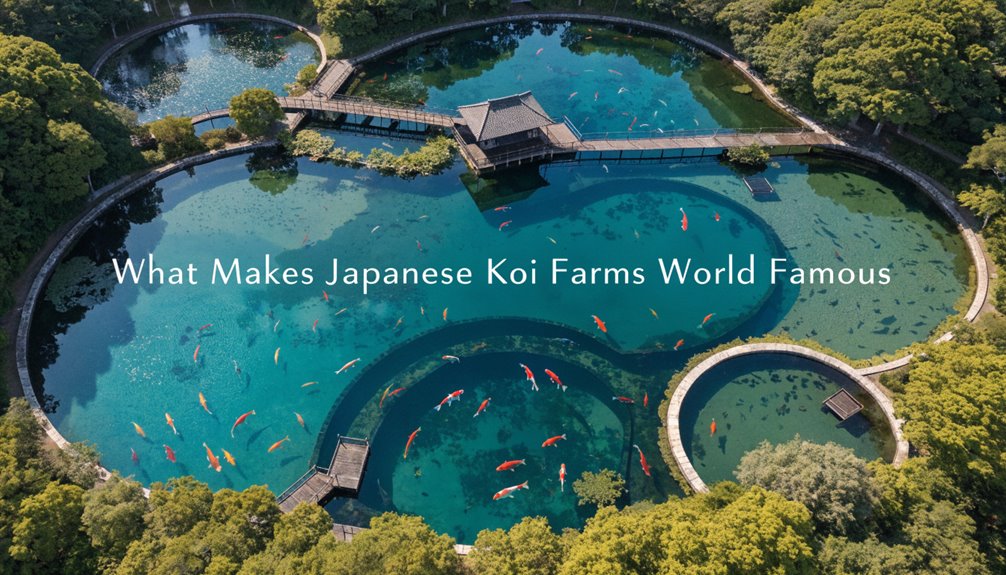
While you might admire koi for their beauty, Japanese koi farms have earned their world-famous status through a combination of geographic advantages, specialized breeding techniques, and a deep-rooted expertise spanning over 150 years.
Ojiya City in Niigata Prefecture, with its mineral-rich water and mountainous isolation, provides optimal conditions that few other regions can replicate. This city is also renowned as the birthplace of Nishikigoi, Japan’s legendary koi fish. Multiple breeding centers like Kawaguchi, Katakai, and Nagaoka concentrate unique bloodlines and specialized practices. Pre-made koi pond kits simplify the process of creating an ideal habitat for these exquisite fish.
Farms employ selective breeding to enhance color, pattern, and size, producing koi specimens regularly exceeding $10,000. Generational knowledge preserves proprietary methods that cultivate championship-quality fish.
International demand sustains these multi-generational family operations, with global export networks and coordinated breeding cycles. This precise combination of environment, expertise, and market infrastructure firmly establishes Japanese koi farms as unparalleled leaders in ornamental fish breeding.
How Koi Breeding Began and Evolved During the Meiji Era
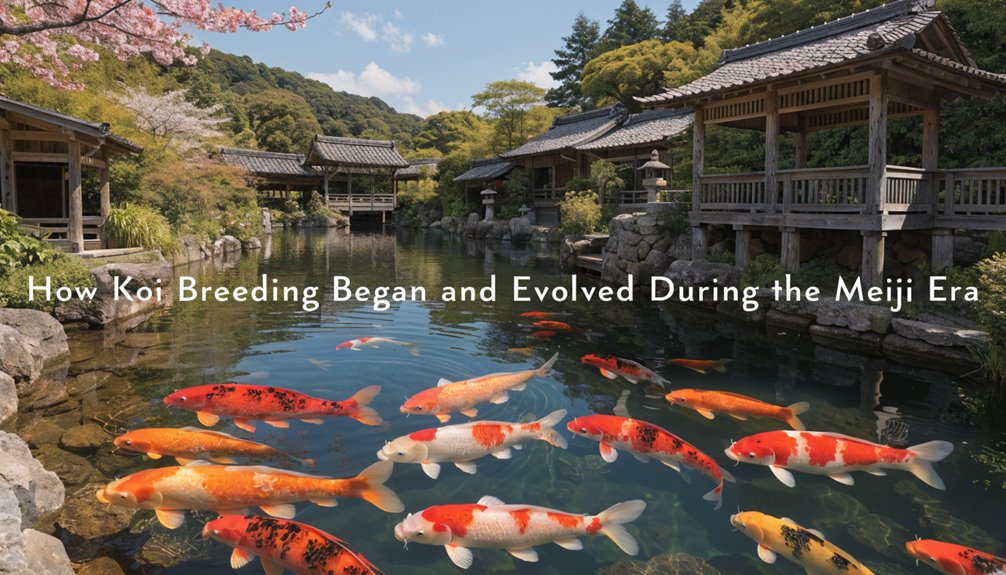
Although koi breeding traces its roots back to the 1820s in Japan’s Nijūmuragō region, it was during the Meiji Era (1868-1912) that the practice evolved into a sophisticated, commercially viable industry. You’ll see that selective crossbreeding techniques advanced dramatically, exemplified by Kunizo Hiroi’s development of the modern Kohaku in 1889. Accurate pond volume calculation became essential for ensuring the health and quality of koi during this period.
The introduction of German carp in 1904 created scale-less (Doitsu) variants, enabling new patterns such as the Shusui through Asagi crossbreeding. By the early 1900s, koi transitioned from leisure pursuits to valuable commodities, with high-quality specimens traded and exhibited publicly by 1908. This period also saw increased appreciation of koi as symbols of strength and perseverance, reflecting their cultural significance.
Economic factors, including the post-Russo-Japanese War boom, drove prices up and prompted sales regulations. Around 1910, the term Nishikigoi was formalized, standardizing nomenclature and solidifying koi breeding as a structured commercial enterprise.
How Ojiya City Became the Heart of Nishikigoi Breeding
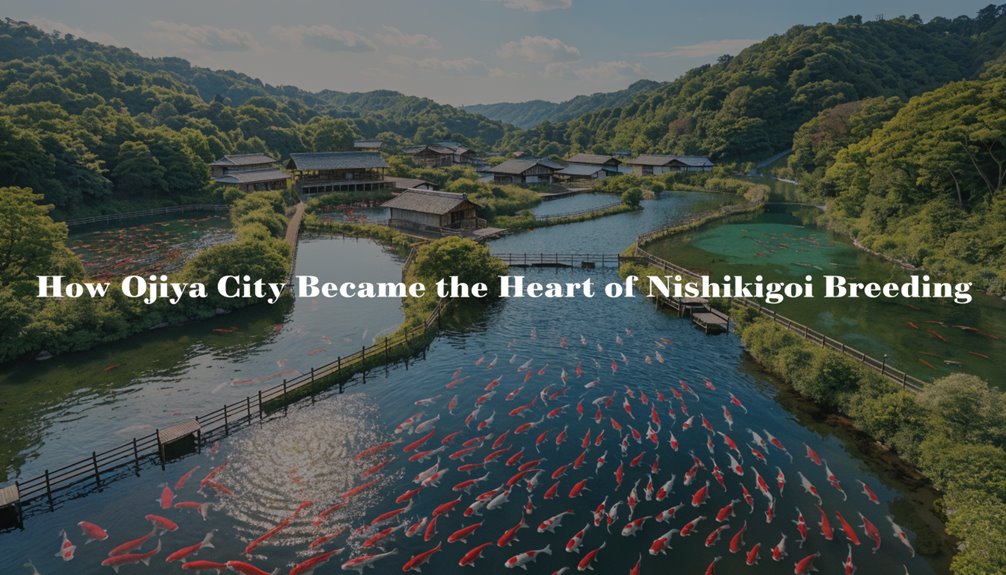
Because of its unique geography and environmental conditions, Ojiya City emerged as the epicenter of Nishikigoi breeding. Nestled in mountainous southern Niigata, Ojiya’s cold winters and abundant Shinano River water created ideal breeding environments. This region is also home to legendary koi breeders such as Dainichi and Marusei Koi Farm, who have set industry benchmarks with their high-quality bloodlines. Additionally, the careful attention to koi habitat design ensures that the breeding conditions remain optimal for healthy development.
You’ll find over 15,000 mud ponds carved into the mountainsides, supporting extensive koi farming alongside rice agriculture.
Key factors defining Ojiya’s prominence include:
- Production scale: 8 to 12 million koi annually, with 400,000 exported worldwide.
- Generational expertise: farms operating over 100 years, preserving bloodlines and refining quality.
- Institutional support: coordinated breeder networks and educational facilities fostering innovation and tradition.
These precise geographic and cultural foundations made Ojiya indispensable to Nishikigoi’s global reputation and sustained excellence.
Unique Breeding Techniques Developed in Niigata Prefecture
Ojiya City’s unique environmental factors set the stage for innovative koi breeding methods that have been refined over generations. You’ll rely on mineral-rich mud ponds where natural clay enhances koi skin quality and color development. These shallow earthen pools provide essential microorganisms for fry nutrition, while stable pH and oxygen-rich spring water optimize pigmentation and growth. Takahashi Koi Farm, located in nearby Uonuma, Niigata Prefecture, exemplifies this tradition by producing about 20,000 koi annually, mainly tosai and some nisai, across a large breeding space.
You’ll manage about ten parent koi pairs per farm, using hormone injections to control spawning timing and cull weak fry promptly, ensuring only strong specimens enter mud ponds. Feeding starts with powdered foods and progresses to high-protein pellets and color supplements like spirulina. Winterizing your koi pond is essential to maintaining their health during the colder months.
Daily water quality monitoring and advanced filtration maintain optimal conditions. This integration of natural environment with precise breeding protocols drives consistent pattern expression and superior koi quality. Takahashi Koi Farm’s emphasis on early pattern definition and solid conformation highlights the farm’s commitment to visual clarity and color saturation.
How Generations of Family Knowledge Drive Koi Success
- Expert evaluation of body shape, color patterns, and health indicators ensures only the best breeding stock is chosen.
- A blend of traditional artistry and modern scientific methods optimizes breeding outcomes. Kodama Koi Farm’s location in Oahu, Hawaii, with its similar mineral content to Niigata, Japan, plays a crucial role in nurturing the koi’s quality. Koi behavior also influences breeding choices, as farms seek to enhance desirable characteristics in their stock.
- Meticulous record-keeping and observation enable refined genetic selection across generations. This continuity guarantees that every koi you raise carries the legacy of perfected techniques and championship potential.
Major Koi Breeding Families and Farms in Niigata
While Niigata Prefecture is renowned as the heartland of Nishikigoi breeding, its major koi farms distinguish themselves through multi-generational expertise and specialized genetic lines.
Marudo Koi Farm, founded by Hisashi Hirasawa in 1970, excels in premium Gosanke varieties, especially jumbo Kohaku and Sanke with firm color clarity. The farm is also well-known for its focus on producing large-format tosai with strong pattern clarity and robust body structure.
Marusei Koi Farm, established in 1960 by Seitaro Hirasawa, expanded into one of Japan’s largest koi operations, specializing in Ogon and Grand Champion Kohaku specimens for global markets.
You’ll also find farms like Yamamatsu with nearly a century of Sanke and Kohaku breeding, Omosako leading in Shiro Utsuri, and Torazo Urakawa focusing on quality Kohaku from Sanke bloodlines.
This regional network emphasizes selective breeding, maintaining genetic integrity and variety essential to Nishikigoi’s worldwide prestige.
Why Dainichi Koi Farm Is a Legend in the Koi World
Major koi farms in Niigata set high standards in selective breeding, but few have achieved the legendary status held by Dainichi Koi Farm. Founded by Minoru Mano in the mid-1900s, Dainichi revolutionized koi quality, focusing on body structure and skin refinement. Their koi are praised for their powerful body shape and rich beni coloration, which consistently set them apart in competitions.
You’ll recognize its impact by:
- Dominating the All Japan Nishikigoi Show with numerous Grand Champion titles, including a 90cm Kohaku winner in 2020.
- Specializing primarily in Kohaku and Showa varieties, producing genetically superior, award-winning koi.
- Implementing state-of-the-art indoor ponds and rigorous inspection protocols to ensure consistent quality.
You can trust Dainichi’s reputation as a global leader, drawing serious collectors and competitors who value its unmatched excellence and refined breeding program.
Why Shinoda Koi Farm Is Renowned for Hi Utsuri Varieties
Because Shinoda Koi Farm has specialized in Hi Utsuri varieties for decades, it’s earned an unmatched reputation worldwide for producing koi with deep sumi and intense hi pigmentation.
You’ll notice their Hi Utsuri exhibit massive body development and stable pattern consistency, even as the koi mature. Their selective breeding protocols emphasize bold sumi and vibrant red hi, maintaining these traits across generations.
Tosai specimens demonstrate rapid growth, reaching up to 40cm in months, with refined body structure enhanced by optimal environmental conditions. The farm is recognized for breeding excellence, especially in Hi Utsuri varieties.
Established in 1952, Shinoda’s continuous genetic improvements and championship-winning bloodlines, like the All Niigata Koi Show Grand Champion Ginrin Showa, bolster their credibility.
As a breeder, you can rely on Shinoda for consistent quality and distinctive Hi Utsuri characteristics unmatched by competitors.
How Sekiguchi Koi Farm Expanded Its Breeding Operations
As Sekiguchi Koi Farm expanded its breeding operations, it strategically leveraged its location in Minami Uonuma, Niigata prefecture—a recognized global hub for premium koi breeding. You’ll find their 40,000 square meter facility supports large-scale breeding programs, focusing exclusively on Showa varieties.
This specialization allowed them to develop the distinctive “Sekiguchi Showa” strain with superior skin quality and patterning. Their strong relationships with breeders ensure access to high-quality Koi at competitive prices.
Their expansion impressed koi enthusiasts by delivering:
- Consistent production of large, well-proportioned koi with exquisite patterning
- Mastery of pearl-scale gene expression, resulting in the unique Pearl Ginrin strain
- Sustained top rankings and Grand Champion titles in national competitions
Why Sakai and Momotaro Koi Breeders Are World-Renowned
While Sakai Koi Farm has established itself as a global leader through over a century of innovative breeding and unmatched achievements, Momotaro Koi also commands respect for its quality and craftsmanship, though detailed data on Momotaro requires further exploration. You’ll recognize Sakai’s dominance in Gosanke varieties, especially Kohaku and Sanke, with powerful body frames and clean shiroji. Their koi exhibit stable beni and rapid growth, prized in global markets. The farm’s legacy began in the 1890s when Ichiroji Sakai started with carp farming for food, laying the foundation for future advancements.
| Attribute | Sakai Koi Farm | Momotaro Koi Farm |
|---|---|---|
| History | 120+ years, 4 generations | Renowned, details scarce |
| Breeding Focus | Gosanke, Kohaku, Sanke | High-quality craftsmanship |
| Achievements | 13 Grand Championships | Respected worldwide |
| Innovation | Early scientific methods | Traditional expertise |
| Market Impact | Multi-million yen sales | Growing international demand |
Key Infrastructure Behind Japan’s Leading Koi Farms
When you examine the key infrastructure behind Japan’s leading koi farms, you’ll find a sophisticated system combining traditional mud ponds and advanced concrete and greenhouse facilities. The Niigata region alone hosts over 15,000 mud ponds carved into mountainsides, each with unique mineral and algae profiles essential for koi development.
Ogata Koi Farm operates 10 greenhouses with 92 concrete ponds, allowing year-round temperature control and breeding precision. The farm produces approximately 150,000 to 200,000 koi annually, with a strong focus on varieties like Benigoi, showcasing its global reputation. You’ll also find specialized breeding and holding facilities supporting thousands of koi at various growth stages.
To appreciate their complexity, consider these:
- Daily monitoring of water parameters ensures optimal koi health.
- Seasonal feeding and maintenance adjust to developmental needs.
- Selective culling focuses production on the top 3% export-quality koi.
This infrastructure guarantees Japan’s koi farms lead globally in quality and innovation.
How Water Quality Influences Koi Farm Operations Worldwide
Because water quality directly impacts koi metabolism, health, and growth, maintaining strict control over parameters like temperature, pH, dissolved oxygen, and nitrogen compounds is essential for koi farm operations worldwide.
You must regulate temperature to optimize metabolic rates and sustain nitrifying bacteria, typically between 25-27°C.
Stable pH prevents stress and sudden mortality, while dissolved oxygen levels dictate stocking density limits and aeration needs.
Managing ammonia and nitrite through effective biofiltration and frequent water exchanges during system startup prevents toxicity. Immediate water quality checks are recommended upon observing any signs of fish distress or unusual water conditions to swiftly address potential problems signs of water quality.
Monitoring total alkalinity ensures buffering capacity against pH fluctuations.
You’ll also need to balance filtration and aeration systems to address oxygen competition, especially in high-density environments.
Regular, precise water testing across multiple tanks safeguards against imbalances that could trigger algae blooms, fish stress, or mortality, ensuring consistent koi health and farm productivity globally.
Why Koi Prices Can Reach Six Figures
Maintaining optimal water quality sets the foundation for raising koi that can command premium prices, but the factors driving six-figure valuations extend far beyond environmental control. You must consider genetics, rarity, and time investment.
First, elite koi descend from decades of selective breeding, ensuring unique, stable patterns and superior body conformation that only a fraction of offspring inherit. Genetic lineage influences the overall quality and market value of koi, making the bloodline a critical consideration for buyers.
Second, these koi require 8–15 years of meticulous care, including specialized diets, rigorous disease control, and careful grading, which intensifies holding costs and risk.
Third, rarity plays a crucial role—one-of-a-kind patterns with exceptional brightness or symmetry make certain specimens irreplaceable and highly sought after.
Combining these elements explains why koi prices can soar into six figures, reflecting their exceptional genetic lineage, laborious cultivation, and unmatched uniqueness.
How Breeders Select and Develop Premium Koi Varieties
Though selecting premium koi begins shortly after hatching, breeders must apply rigorous criteria to identify individuals with the highest potential for growth, pattern, and structure. You’ll see early senbetsu cull weak fish to maintain low densities, optimizing growth and water quality.
Body structure takes precedence—thick, balanced frames that endure aging. Skin quality must be bright and clean, serving as the canvas for sumi, hi, and shiroji patterns, which are evaluated for depth, evenness, and symmetry. Heavy culling is essential to filter out weak or poorly patterned fish, thereby improving skin quality and pattern clarity.
Multi-generation breeding programs refine traits like sumi stability and mature pattern development by pairing only elite broodstock. Controlled environments and tailored nutrition further enhance structural and color expression.
You won’t just chase size; instead, you develop koi with balanced form and vibrant, lasting patterns that define premium varieties.
How Kodama and Fitz Fish Ponds Distribute Japanese Koi Worldwide
When you choose koi from Kodama or Fitz Fish Ponds, you benefit from their direct import relationships with top Niigata breeders like Dainichi and Marusei. This ensures only the strongest-bodied fish with pristine skin reach North America.
Their multi-location distribution networks span Florida, New York, and New Jersey, enabling faster deliveries and live inventory viewing. Online sales platforms further streamline your purchasing experience, displaying detailed koi specifications and facilitating direct orders. Both Kodama and Fitz Fish Ponds offer a wide selection of koi varieties to suit backyard ponds or show-quality displays.
Here’s why their distribution excels:
- Direct sourcing eliminates intermediaries, guaranteeing quality and authenticity.
- Seasonal shipping aligns with optimal water temperatures, safeguarding fish health.
- Multiple hubs provide broad geographic reach and prompt customer service.
This precision-driven system assures you receive premium Japanese koi efficiently and reliably.
Why Visiting Japanese Koi Farms Is a Must for Enthusiasts
Because Japanese koi farms represent the origin of Nishikigoi selective breeding, visiting them offers enthusiasts unparalleled access to the most extensive and authentic koi varieties. You’ll directly evaluate breeding stock in optimal water conditions and select fish prior to distribution, ensuring quality and authenticity.
Interacting with master breeders grants insight into genetic lineages, breeding philosophies, and strain development, enabling informed purchasing decisions. Additionally, the cultural immersion in Niigata—the cradle of ornamental carp evolution—deepens your appreciation for koi as living art, influenced by Zen principles and traditional garden aesthetics.
These visits also connect you to the global koi industry, fostering professional networks and exposure to cutting-edge breeding techniques. For enthusiasts, farm visits are essential for acquiring superior koi and advancing expertise in cultivation and care.
Frequently Asked Questions
What Are the Ideal Water Temperatures for Koi Health and Growth?
You should maintain koi water temperatures between 65°F and 75°F (15°C to 25°C) for optimal growth and immune function. Temperatures above 82°F (28°C) reduce oxygen and hinder performance, risking koi health.
How Often Should Koi Ponds Be Cleaned and Maintained?
You should clean koi ponds thoroughly once or twice yearly, with weekly skimmer basket cleaning and biweekly partial water changes. Daily debris removal and routine filter maintenance keep water clear and fish healthy, ensuring balanced biofiltration.
What Diseases Commonly Affect Koi and How Are They Treated?
You’ll encounter Ich, flukes, bacterial fin rot, and Koi Herpes Virus often. Treat with specific antibiotics, antifungals, or salt baths, isolate infected fish, maintain water quality, and physically remove parasites like anchor worms promptly for effective control.
How Long Do Koi Typically Live in Captivity?
You might think koi live only around 15 years, but with proper care, they often reach 25-35 years. Japanese koi can exceed 40 years, thanks to genetics, water quality, diet, and disease prevention efforts.
What Are the Best Feeding Practices for Koi Fish?
Feed your koi 1-3 times daily above 73°F, reducing to once daily or less as temperature drops. Limit portions to what they consume in 5 minutes, avoid overfeeding, and use protein-rich, size-appropriate food with spirulina.
Conclusion
When you explore world-famous Japanese koi farms, you’re stepping into a living legacy that echoes the meticulous artistry of Meiji-era breeders. Just as a master painter perfects each brushstroke, these farms refine every koi through generations of expertise. Understanding their unique techniques and global influence reveals why koi command such value. Visiting these farms isn’t just a trip—it’s an immersion into a vibrant tradition where science, patience, and passion converge to create living masterpieces.