You pay more for expensive koi because their value lies in carefully selected genetics, documented lineage, and rare, vibrant color patterns like Goshiki. Symmetrical, crisp patterns and ideal body shape—especially in females with broad, torpedo-shaped bodies—boost their worth. Size, age, and health strongly influence price, as does expert care maintaining their longevity and vividness. Understanding these precise traits reveals why certain koi command such premium prices and hold enduring appeal.
Key Facts Summarized
- Expensive koi have superior genetics, proven lineage, and documented pedigree from renowned breeders ensuring authenticity and premium quality.
- Rare and intricate color patterns, like Goshiki’s five-color blend, significantly increase koi’s visual appeal and market value.
- Large size, perfect body symmetry, and well-defined, balanced patterns demonstrate advanced breeding and higher maturity, driving up prices.
- Healthy koi with disease-free status, maintained by expert care and optimal water conditions, command higher market worth.
- Female koi with broader, torpedo-shaped bodies have greater reproductive value, increasing their desirability and price among breeders.
How Selective Breeding Shapes Koi Genetics

Although koi descend from common carp, selective breeding over generations has significantly shaped their genetics, producing the vibrant colors, unique patterns, and varied scale types you see today. You’ll find that traits like pigmentation—red, white, black, yellow—pattern layout, and scale type are inherited from parent fish called oyagoi.
Breeders select oyagoi based on body conformation, coloration, size potential, and health to optimize offspring quality. Despite careful pairing, genetic expression remains complex and partly unpredictable due to multiple interacting genes and environmental influences. Modern breeding techniques often blend traditional knowledge with technology, including hormone treatments and controlled environments, to improve spawning success.
Scale type inheritance is more predictable, with metallic scales dominating normal scales in offspring. Breeding programs also introduce new genetic material through hybridization to expand allele combinations, aiming to generate novel phenotypes.
Your breeding success depends on understanding these precise genetic foundations and selection criteria.
Why Documented Lineage Boosts Koi Value

Selective breeding not only shapes koi genetics but also establishes a documented lineage that significantly impacts their market value. When you invest in koi with certified pedigree from renowned breeders like Marudo or Sakai, you’re paying for proven genetic potential passed through generations. This documentation ensures authenticity, boosts resale value, and justifies premium pricing beyond mere appearance. The value of koi can also be likened to how complex systems, such as server-rendered React components, rely on well-structured modules to deliver consistent results, emphasizing the importance of reliable lineage and provenance. Additionally, high-quality koi food, rich in essential nutrients, can enhance the overall health and vibrancy of these prized fish, further elevating their value.
Consider these key factors:
- Champion lineage: Koi with show-winning ancestry command exponentially higher prices due to validated performance.
- Breeder reputation: Trusted breeders reduce risk, elevating demand and price for certified specimens.
- Certification: Paperwork verifying origin and genetics prevents fraud, increasing market transparency and confidence server-rendered React components.
Why Rare Color Patterns Like Goshiki Stand Out
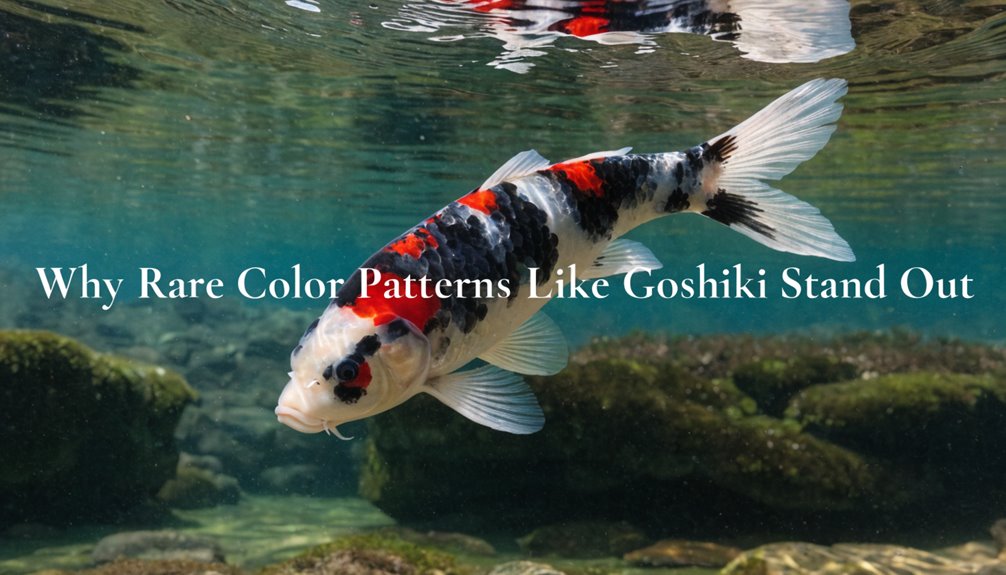
When you evaluate koi color patterns, rare varieties like Goshiki stand out due to their unique five-color composition and intricate genetic basis. Goshiki combines red, white, black, blue, and gray, produced by complex interactions between Sanke and Asagi genetics. This genetic complexity makes consistent reproduction challenging, as recessive traits can remain hidden for generations. Understanding genetic inheritance is essential for developing and maintaining such unique koi varieties. Visually, Goshiki displays distinct black reticulation resembling fishnet over a white or dark base, with bold, neon-like red plates that contrast sharply. Additionally, pattern quality plays a critical role in determining the overall value of Goshiki among collectors. Environmental factors—like water temperature and diet—directly influence pigment intensity, altering color vibrancy and pattern expression throughout the fish’s life. These variables, combined with the difficulty of selective breeding to balance color and pattern, result in Goshiki’s rarity and prestige. This rarity makes Goshiki highly valued among koi enthusiasts.
How Pattern Quality Determines Koi Price
Since pattern quality directly influences a koi’s market value, understanding its key components is essential for any serious collector or breeder. You’ll want to focus on pattern symmetry, intricacy, and edge definition, as these factors significantly impact pricing and desirability.
- Symmetry and Balance: Perfectly balanced patterns, like symmetrical red steps on a white Kohaku, signal superior genetics and elevate value.
- Pattern Complexity: Multi-step designs, especially 4-5 step Kohaku, demonstrate advanced breeding techniques and command higher prices than simpler patterns.
- Crisp Edges: Sharp, well-defined color boundaries without bleeding or blemishes indicate premium lineage and boost market appeal.
Mastering these elements helps you assess koi worth accurately, ensuring you invest in high-quality specimens that reflect exceptional breeding and pattern precision. Additionally, color harmony and the presence of multiple distinct color steps add desirability by enhancing the koi’s unique beauty.
How Koi Size and Growth Affect Their Value
Pattern quality plays a significant role in determining koi price, but size and growth rates also heavily influence market value. Larger koi—typically 24-28 inches—command substantially higher prices, especially jumbo bloodlines exceeding 30 inches and 20+ pounds, which represent premium segments.
Growth potential hinges on genetics; superior bloodlines produce larger specimens with accelerated growth rates of 1-2 inches per month under optimal conditions. Environmental factors such as pond size (minimum 1,000 gallons), water quality, temperature stabilization near 75°F, and proper stocking densities critically support size realization. It is important to note that koi typically do not reach Jumbo size in a 2,000-gallon pond due to environmental limitations pond size limitations. Maintaining accurate pond volume is essential for creating optimal growth conditions.
Nutritional programs using high-protein, vitamin-rich diets further maximize growth and color development. Failure to meet these conditions limits size achievement, regardless of genetics, significantly diminishing market value.
Consequently, size progression from juvenile to mature stages exponentially increases resale worth in competitive markets.
How Expert Care Increases Koi Market Prices
Although koi size and genetics set the foundation for value, expert care significantly elevates market prices by ensuring optimal health, growth, and appearance. You’ll find that meticulous management—from genetics to environment—directly influences koi quality and desirability. The reputation of breeders also plays a crucial role, as fish from respected sources often command higher prices due to breeder reputation.
Expert breeders maintain pristine water conditions and specialized diets, which promote flawless skin and vibrant colors. Health certifications validate disease-free status, increasing buyer confidence and price.
Moreover, years of dedicated care and monitoring ensure koi reach market readiness with ideal body shape and vitality.
Key factors include:
- Controlled growing environments with superior water quality and nutrition
- Rigorous health assessments and USDA APHIS certifications guaranteeing disease-free specimens
- Extended time investment by experienced breeders ensuring optimal growth and appearance
This expert care justifies premium pricing in competitive koi markets.
How Age and Longevity Influence Koi Worth
When you evaluate koi value, age plays a crucial role in determining market worth. Younger koi under 14 years often carry higher prices due to growth potential, but mature koi exhibit refined patterns and vibrant colors that collectors prize. Exceptional quality and rarity in older koi command premium rates. Longevity also drives value; Japanese bloodlines average 40 years and can exceed 60, with extraordinary specimens living over 100 years. The pattern quality and crispness of koi also significantly influence their appeal and pricing. Genetic lineage influences lifespan and breeding value, with strong bloodlines producing healthier, longer-lived offspring, which increases worth. Additionally, the proper filtration system is essential for maintaining the health of koi, further impacting their market price. Health assessments correlate directly with longevity and market price—robust, disease-free koi are more valuable. Furthermore, hibernation during cold winters enhances physiological resilience, extending lifespan, whereas year-round warm-water conditions reduce it. Thus, both age and longevity intricately affect koi valuation in the marketplace.
Why Female Koi’s Body Shape Commands Higher Prices
Understanding koi value extends beyond age and longevity to the distinct physical traits that influence market demand. Female koi develop larger egg masses, which widen their bodies, creating the ideal torpedo shape prized in the market. This torpedo body shape is essential for ensuring effective swimming and overall health in koi.
This body shape isn’t just aesthetic—it directly reflects reproductive potential, making females more valuable for breeding. Additionally, body shape influences overall desirability and price, highlighting why females typically fetch higher prices than males.
You should note these key factors:
- Females’ wider physiques result from substantial egg production capacity, increasing their mass and market appeal.
- Breeders prioritize females for genetic continuation, as they can produce thousands of offspring, boosting their breeding value.
- The torpedo body shape aligns with show standards, enhancing females’ competitive and resale value significantly.
This combination of reproductive biology and shape makes female koi command higher prices than males.
How Koi Body Shape Impacts Show Quality and Price
Because koi body shape directly signals health, genetic quality, and swimming efficiency, it serves as the primary standard in show evaluations and market pricing. You’ll notice that a perfect torpedo-shaped koi, widest at the pectoral fins with symmetrical fins, commands the highest classification and value. Defects in body conformation immediately downgrade show potential, regardless of coloration. Larger, well-proportioned koi indicate maturity and genetic strength, further boosting price. Additionally, adult koi aged between 2-4 years generally command higher prices due to their developed size and established traits, making age an important factor in valuation adult koi pricing.
| Aspect | Impact on Quality & Price |
|---|---|
| Torpedo Shape | Essential for show classification |
| Symmetry | Indicates prize-winning quality |
| Size | Correlates with maturity and value |
| Defects | Cause automatic downgrade |
You should prioritize koi body shape as the cornerstone for assessing both show quality and market worth.
Why Complex Color Blends Make Koi More Valuable
Although koi body shape sets the foundation for value, complex color blends significantly elevate a koi’s market worth by showcasing rarity and aesthetic sophistication. You’ll find that koi with intricate color patterns, exceptional pigmentation intensity, and balanced symmetry command premium prices due to their visual impact and genetic rarity.
Master breeders have refined these traits over generations, producing koi with vivid, crisp color edges and harmonious blends that collectors highly prize.
Key factors include:
- Rare multi-color blends like Goshiki’s five-color mix and Kikokuryu’s metallic contrasts increase desirability.
- Intense, uniform pigmentation with sharp pattern clarity drives valuation higher.
- Symmetrical, well-distributed color patterns, including precise Tancho markings, enhance market value dramatically.
Frequently Asked Questions
How Do Koi Breeders Prevent Inbreeding While Maintaining Elite Bloodlines?
You prevent inbreeding by pairing unrelated elite koi, rotating family lines, tracking pedigrees to calculate kinship, and culling weak offspring rigorously. You also introduce diverse bloodlines and outcross selectively to maintain vigor while preserving elite traits.
What Are the Common Health Issues in High-Value Koi?
You’ll encounter parasitic diseases like Ich, bacterial infections such as Aeromonas ulcers, viral threats including Koi Herpesvirus, and water-quality issues like ammonia poisoning. Vigilant monitoring and prompt treatment are essential to safeguard high-value koi health.
How Does Water Quality Specifically Impact Koi Coloration?
Imagine vibrant koi colors fading like a sunset—poor water quality stresses your fish, causing pigment loss. Maintaining balanced pH, eliminating nitrites, and ensuring clean, oxygenated water preserves their vivid reds, whites, and dark spots effectively.
Are There Ethical Concerns in Selective Koi Breeding Practices?
Yes, you should consider ethical concerns in selective koi breeding because prioritizing aesthetics often compromises health, reduces genetic diversity, increases disease susceptibility, and creates welfare issues, raising responsibility questions about sustainable and humane breeding practices.
What Is the Typical Lifespan of a Show-Quality Koi in Captivity?
You can expect show-quality koi to live 25-35 years in captivity with proper care. Japanese-bred koi often reach around 40 years, while exceptional specimens may exceed 50 years under optimal environmental and genetic conditions.
Conclusion
You’ll find that the value of expensive koi hinges on precise genetics and documented lineage, with rare patterns like Goshiki increasing worth significantly. Did you know top-tier koi can command prices over $100,000 due to their size, age, and body shape? Understanding these factors helps you appreciate why selective breeding and complex color blends create koi prized not just for beauty, but for their genetic excellence and show quality.