To buy show-quality koi, start by choosing trusted dealers with strong biosecurity and champion bloodlines. Inspect the fish’s full, symmetrical body, clear eyes, healthy gills, and smooth, unmarred scales like Gin Rin or Matsuba. Look for balanced, vibrant color patterns and precise markings typical of winning varieties like Kohaku or Showa. Ensure the koi exhibits active behavior and flawless fins. These core steps set you up for success, and exploring deeper details will sharpen your selection skills further.
Key Facts Summarized
- Choose reputable dealers with champion lineages and strong biosecurity, like Kodama Koi Farm or Blackwater Creek Koi Farms.
- Inspect koi for full, rounded bodies, clear eyes, healthy red gills, and active behavior indicating robust health.
- Evaluate scale types such as Wagoi, Gin Rin, Matsuba, and Doitsu for uniformity, sparkle, and pattern quality.
- Assess body shape for symmetry, a torpedo-like form, broad head, and balanced fins to ensure structural integrity.
- Select varieties with clear, crisp colors and patterns, focusing on Kohaku, Sanke, Showa, and metallic types for show standards.
Find Trusted Dealers for Show-Quality Koi

Where should you start when looking to buy show-quality koi? Begin with trusted dealers known for champion lineages and rigorous biosecurity. Kodama Koi Farm offers jumbo koi from Japan’s top breeders, while Blackwater Creek Koi Farms operates biosecure facilities guaranteeing healthy, American-bred fish. Kodama Koi Farm also benefits from Florida’s 11-month growing season, allowing them to produce high-quality fish year-round from Bio Secure farms. Additionally, look for dealers who implement quarantine procedures to ensure the health of their stock.
Fitz’s Fish Ponds hand-selects from reputable Japanese breeders, ensuring quality and quarantine compliance. Family-owned ChampKoi boasts 4.8-star reviews and live-arrival guarantees, reflecting reliability.
Online retailers like Play It Koi and Sacramento Koi provide verified sourcing with return policies and detailed variety selections, including Kohaku and Showa.
Prioritize dealers who maintain health guarantees, lineage documentation, and responsive customer service. This approach ensures you access superior genetics, vibrant color, and reliable delivery, essential for acquiring koi worthy of competitive showing.
Evaluate Physical Health Indicators in Show Koi

How can you confidently determine if a koi possesses the physical health necessary for show quality? Begin by assessing its body condition—look for a full, rounded shape without any sunken areas behind the gills, which signal poor nutrition or health issues.
Examine the skin and scales; they should lie flat with no raised scales or damage, as these defects suggest illness. Check the fins to ensure they extend fully without ragged edges or clamping.
Observe the eyes and gills closely—clear eyes and healthy, red gills free of mucus or bleeding indicate vitality. Additionally, be aware that overpopulation issues can lead to stress, which may affect the koi’s health and appearance.
Finally, watch the koi’s behavior: active, purposeful swimming and eager feeding demonstrate good health, while lethargy or erratic movements warn of stress or disease, disqualifying it from show consideration. Regularly monitoring water quality helps prevent underlying causes of health problems, such as poor water quality.
Assess Scale Types and Pattern Quality
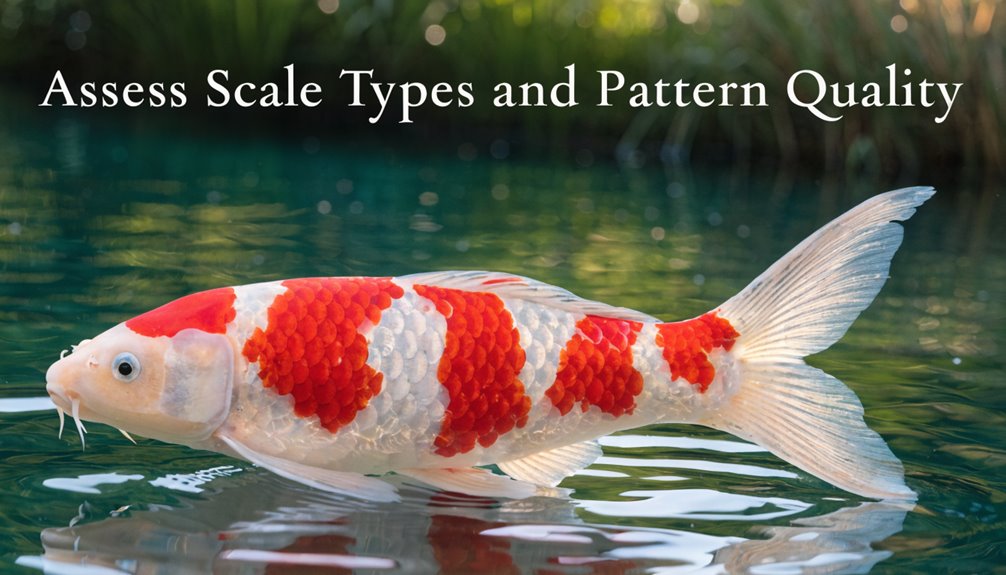
Although a koi’s overall health and body shape are crucial, assessing scale types and pattern quality plays an equally vital role in determining show potential.
You’ll want to identify the standard Wagoi scales for their soft, uniform appearance, ensuring consistent size and definition aligned with the koi’s variety.
Gin Rin scales, with their diamond sparkle, must have at least three full rows and a reflective quality distinct from metallic types.
Matsuba scales show pine-cone-like black markings centered on each scale, creating a netted effect that demands precise placement and depth.
For Doitsu koi, evaluate the unique scale arrangements—whether scaleless Leather, mirror-like Kagami, or scattered Armor patterns—paying close attention to color separation and clarity.
Uniformity, symmetry, and variety-specific standards in scale patterning directly influence a koi’s competitive value, while owners often enjoy observing their fish’s gradual ontogenetic metamorphosis as patterns evolve over time.
Analyze Body Shape and Symmetry of Show Koi
When evaluating show-quality koi, you must scrutinize the body shape and symmetry with exacting detail, as these physical traits reveal the fish’s structural integrity and competitive potential.
Look for a smoothly flowing body with a visible, straight spine beneath the skin and balanced proportions from head to tail. The ideal koi has a torpedo shape: its widest point lies between the gill plates and dorsal fin, tapering gracefully at both ends. Body shape acts as a canvas, with patterns as finishing touches. A well-formed body is essential for maximum growth potential, so prioritize koi with the best structural characteristics.
Check that the head is broad with a rounded nose and a gently convex forehead, avoiding sharp angles.
Assess bilateral symmetry carefully—both sides should mirror each other, with identical fins and matching tail lobes.
The body contours should create an elliptical form with seamless line flow, showcasing power without excess fat or thinness. This focus on body shape ensures the quality reflects breeder skill and effort, reducing reliance on luck in koi valuation.
Choose Koi Varieties and Colors That Win
Selecting koi varieties and colors that consistently win at shows demands a keen understanding of their distinct traits and judging criteria.
Start with Kohaku, the foundational variety prized for its pure, bright white body and striking red (hi) markings with clear, crisp lines, which develop fully in mature fish.
Consider Sanke and Showa tricolors next; Sanke’s elegant white base with red and black contrasts sharply, while Showa’s bold black, red, and white patterns create dynamic movement.
For metallic allure, Ogon’s unblemished platinum or yamabuki hues and Ginrin’s sparkling scales dazzle judges. These metallic koi, known for their shiny, easy to maintain qualities, are also favored for their friendly temperament.
Blue varieties like Asagi showcase blue with red and white accents, while specialized types such as Butterfly koi flaunt flowing fins.
Each variety’s precise color separations and pattern clarity prove crucial for winning koi.
Learn Show Standards and Pick Winning Koi
Understanding which koi varieties and colors catch the judges’ eyes sets a solid foundation, but winning at shows demands mastering the specific standards used to evaluate each fish. Focus on body conformation, color quality, skin condition, and pattern balance to pick koi that excel in every category. You’ll also want to consider deportment—how the koi behaves under show conditions. Accurate pond volume calculation is essential for ensuring a healthy environment for your koi, which can enhance their performance at shows. Blackwater Creek’s grading system reflects a combination of conformation, color, and pattern to ensure high-quality koi selection.
| Criterion | Key Focus |
|---|---|
| Body Conformation | Straight head, balanced fins, wide structure |
| Color Quality | Vibrant, uniform, glossy, and fully developed |
| Skin & Scales | Smooth texture, convex scales, premium sheen |
| Pattern Balance | Proportional, sharp edges, variety-specific |
Frequently Asked Questions
How Often Should I Feed Show-Quality Koi for Optimal Health?
You should feed show-quality koi 2-4 times daily between 70-85°F, adjusting to 1-2 times in cooler temperatures. Always offer only what they consume in 3-5 minutes to maintain health and water quality.
What Is the Ideal Pond Size for Raising Show Koi?
You’ll want a pond at least 3,000 gallons, ideally 23-25 feet long, 12-13 feet wide, and 3-4 feet deep. This size supports stable water conditions and gives each koi ample space for healthy growth.
How Do Seasonal Water Changes Affect Koi Coloration?
Seasonal water changes refresh minerals and balance pH, enhancing pigment saturation and preventing color fading. You’ll notice koi colors deepen with hard water minerals, while dilution of dissolved organics keeps hues vibrant and stress-free.
Can Show-Quality Koi Be Bred at Home?
You can breed show-quality koi at home, but it’s no walk in the park. You’ll need carefully selected mature parents, precise water conditions, dedicated tanks or ponds, and vigilant fry management to ensure top-tier offspring.
What Are Common Koi Diseases and Their Prevention Methods?
You’ll encounter diseases like Ich, fin rot, and KHV. Prevent them by quarantining new fish, maintaining optimal water quality, avoiding overcrowding, using UV sterilizers, and performing regular water tests to keep your koi healthy and thriving.
Conclusion
When buying show-quality koi, remember: you’re not just choosing fish, you’re selecting living masterpieces. Trust only reputable dealers, inspect health and scale precision meticulously, and evaluate body symmetry with a keen eye. Know the winning varieties and colors, and internalize show standards to ensure your koi stands out. Like a jeweler appraises gems, your attention to detail will turn your koi purchase into a show-ring champion. Don’t settle—choose excellence.