You’ll master koi genetics by understanding how pigment genes like Hi (red), Shiro (white), and Sumi (black) interact with dominant and recessive alleles to produce vibrant colors and complex patterns. Scale types—metallic, Gin Rin, Doitsu—inherit through predictable genetic mechanisms influencing appearance and texture. Environmental factors such as water quality and temperature modulate pigment expression and stability. Age and maturation affect reproductive success and body shape. This knowledge forms the foundation for effectively managing breeding and creating new koi varieties.
Key Facts Summarized
- Koi coloration arises from foundational pigments Hi (red), Shiro (white), Sumi (black), and additional colors influenced by genetic combinations and mutations.
- Scale types like Doitsu, Leather, Mirror, and Gin Rin result from specific genetic mutations affecting scale development and reflectivity.
- Dominant and recessive alleles interact polygenically to determine koi color patterns, scale types, and body shape traits.
- Environmental factors such as water quality, temperature, and diet influence pigment expression, color vibrancy, and pattern clarity in koi.
- Selecting breeding stock requires prioritizing stable, vivid colors, symmetrical patterns, proper scale types, and maturity to ensure desired genetic outcomes.
Introduction To Koi Color And Pattern Genetics

When you explore koi genetics, you’ll find that three foundational colors—Hi (red), Shiro (white), and Sumi (black)—form the genetic basis for most koi varieties. These core pigments combine through multiple alleles, creating a broad spectrum of coloration, from simple monochromes to intricate multi-colored patterns. Additionally, some koi exhibit ontogenetic color shifts, where pigmentation intensity and patterns can change over time without altering the variety. Understanding the role of Beni quality is crucial in enhancing koi attractiveness, as it directly influences market appeal.
Additional foundational colors like Ki (yellow), Ogon (metallic), and Muji (single-colored) further diversify the genetic palette. Understanding these base colors is essential, as selective breeding manipulates their interactions to develop specific patterns and varieties.
The resulting color pattern classification system organizes koi by color count—single, bi-, tri-, or multi-colored—while also considering pattern placement, using precise Japanese terminology. Mastering this genetic foundation allows you to appreciate how complex koi patterns arise from these elemental pigments.
Understanding Dominant And Recessive Pigmentation Genes
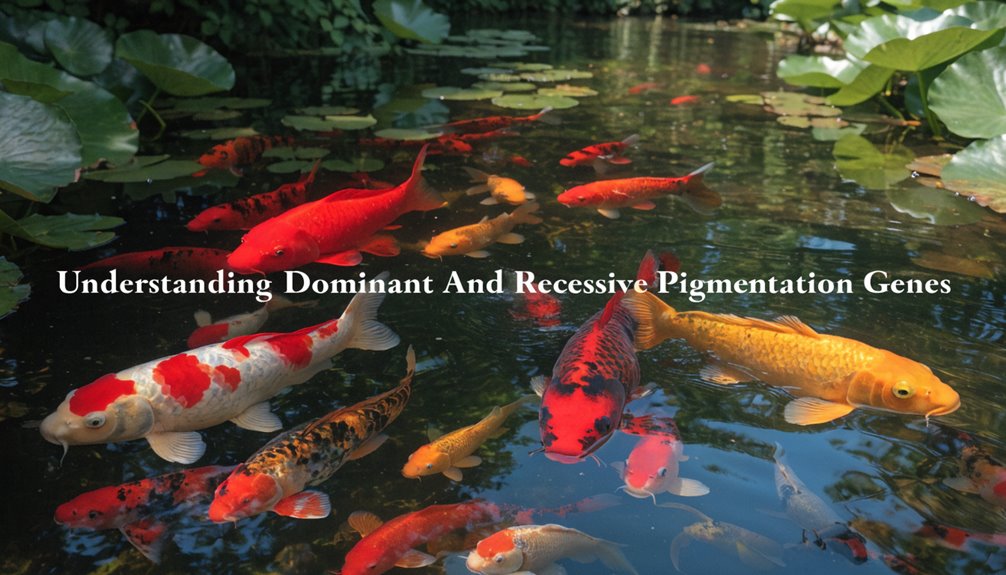
Dominant and recessive pigmentation genes govern the visible traits you observe in koi by dictating how color patterns are inherited and expressed. Dominant alleles like the “design” mutation (D) produce distinct phenotypes such as yellow dorsal stripes and specific head ornaments, masking recessive alleles when heterozygous.
Similarly, the dominant red-eyed allele (R) overrides recessive forms, influencing larval pigmentation in hybrid crosses. In contrast, recessive pigmentation genes require homozygosity to manifest traits like melanin depigmentation or steel coloration, controlled by alleles such as b1, b2, or r.
These recessive mutations only appear phenotypically when both gene copies carry the mutation. Complex gene regulation and epistatic interactions further modulate expression, with multiple loci influencing final pigmentation. Therefore, understanding koi habitat design is essential, as it can contribute to the visibility of certain pigmentation traits in a thriving environment.
Thus, understanding genotype combinations precisely predicts koi’s visible coloration.
Understanding Genetic Differences Between Metallic And Normal Scales

Although metallic and normal koi scales may appear similar at a glance, their genetic and structural differences profoundly affect their reflective properties and overall appearance. Metallic koi produce luster from the skin itself, creating a polished metal look with even light reflection across the body and fins. Normal scales, especially Gin Rin varieties, reflect light via excess guanine crystals within iridophores, yielding a diamond-like sparkle. Cytoplasm thickness also varies, influencing transparency and reflectance. These genetic traits have evolved over millions of years as part of the fish’s natural defense mechanisms, contributing to both their appearance and survival strategies through strong genetic traits. Additionally, the water quality in which koi are raised can further influence their growth and scale development.
| Feature | Metallic Scales | Normal (Gin Rin) Scales |
|---|---|---|
| Light Origin | Skin surface luster | Guanine crystal-rich scales |
| Iridophore Density | Sparse | Dense with stacked crystals |
| Cytoplasm Thickness | Thicker (~155-175 nm) | Thinner (~86-108 nm) |
Understanding these distinctions is key to appreciating koi’s visual diversity.
How Scale Types Inherit And Affect Koi Appearance
Understanding the genetic mechanisms behind koi scale types provides insight into how specific patterns and appearances manifest in individual fish. You’ll find that Doitsu koi scales arise from a mutation altering scale development, producing three main patterns: Leather, Mirror, and Armor. When you cross Wagoi (fully scaled) with Doitsu, offspring display varied scale phenotypes, reflecting polygenic or incompletely dominant inheritance. Mirror scales form reflective dorsal and ventral lines, while Armor scales scatter irregularly, creating patchwork effects. Wagoi koi breed true for full scaling but can carry recessive Doitsu alleles, causing segregating scale patterns in hybrids. Additionally, the Gin Rin mutation independently modifies scale reflectivity on any base type. These genetics combined shape koi’s distinctive appearances, enabling you to predict and select desired scale traits with precision. The interplay of scale texture and pattern diversity, such as Matsuba and Gin Rin, further enriches the visual appeal of koi beyond simple scale presence or absence. Moreover, feeding koi premium foods rich in essential nutrients can enhance their overall health and coloration, further influencing their appearance.
The Role Of Pattern Genes In Kohaku, Showa, And Goromo
When you examine the pattern genes in Kohaku, Showa, and Goromo koi, you’ll find that each variety builds upon foundational genetic templates while expressing unique modifications that define their distinctive appearances.
Kohaku establishes the base with its red (hi) markings on a snow-white body, setting pattern standards essential for quality.
Showa overlays Kohaku’s red and white with Utsuri black, necessitating a tri-color presence on the head, shoulders, and tail, plus characteristic Hachiware head patterns.
Goromo derives from a Kohaku-Asagi cross, incorporating matsuba reticulation over the red scales, expressed as blue or reddish-black netting. A defining feature of Koromo varieties is the half-moon-shaped indigo scale tips that create a distinctive robe-like pattern.
Each variety’s pattern genes dictate precise color placement, edge clarity, and scale reticulation, guiding breeders in selecting traits that uphold genetic integrity and phenotypic excellence within these iconic koi varieties.
Why Environment Changes Koi Colors
Since koi colors result from complex interactions among pigment cells and environmental factors, changes in water quality, sunlight exposure, temperature, diet, and stress can directly alter their appearance.
Poor water quality and imbalanced pH degrade pigment vibrancy, with mineral content influencing color saturation—hard water intensifies blacks, while reverse-osmosis water dulls them. Maintaining water quality is essential for vibrant koi colors.
UV radiation bleaches carotenoid-based hues like hi and yamabuki yellow, while insufficient light weakens sumi pigmentation.
Temperature modulates metabolism; warm water enhances reds and blacks, cold induces pastel tones. Additionally, seasonal temperature fluctuations can cause natural variations in koi coloration throughout the year.
Dietary carotenoids from spirulina and shrimp are essential for sustaining red and yellow pigments, as koi can’t synthesize them.
Stress, including overcrowding and oxygen deprivation, destabilizes astaxanthin in red pigments, causing fading.
You must maintain optimal environmental parameters to preserve vibrant koi coloration and prevent irreversible pigment loss.
How Koi Body Shape And Size Inherit
Although koi body shape and size appear visually straightforward, their inheritance involves intricate genetic interactions shaped by selective breeding and crossbreeding with various carp strains.
Juvenile koi exhibit a torpedo shape controlled by homozygous dominant scale genes (SS or Ss), while recessive ss alleles from mirror carp yield doitsu varieties with elongated bodies and partial scalation. Doitsu scales are typically larger than wagoi scales due to their origin from mirror carp.
The S and N loci influence scale coverage and indirectly affect body contours, with the N locus modifying phenotypes toward leather carp or linear forms.
Adult koi develop pronounced shoulder humps or irregularities genetically predetermined by their bloodlines, revealing maturation-linked transformations.
Offspring within a single spawn show diverse body shapes due to heterozygous parental genetics, while long-term selective culling preserves desired morphologies.
Environmental factors may enhance growth but don’t alter the genetically fixed base body shape.
How To Select Breeding Stock For Ideal Genetic Traits
To achieve optimal genetic traits in your koi breeding program, you must carefully evaluate and select broodstock based on distinct criteria including coloration, pattern quality, health status, and structural characteristics. Prioritize koi with vivid, balanced colors and symmetrical patterns to enhance offspring quality. Exclude fish exhibiting muddy or inconsistent hues. Select only healthy koi with no deformities or diseases, demonstrating robust vitality and resilience to environmental conditions. Structural traits like scale type and conformation must align with breeding goals, ensuring consistent scale placement and absence of defects. It is essential to choose koi that are at least three years old, roughly 10 inches in length, to ensure sexual maturity and a higher likelihood of healthy reproduction.
| Criterion | Key Selection Points |
|---|---|
| Color & Pattern | Vivid, stable colors; symmetrical patterns |
| Health & Vitality | Disease-free; robust body; environmental resilience |
| Structural Traits | Desired scale type; even scale distribution |
Identifying Male And Female Koi For Breeding
When identifying male and female koi for breeding, you’ll rely on several physical and behavioral indicators that become most pronounced in mature fish. It is important to understand that koi are easier to sex when they are mature, around 3 years old and approximately 10 inches in length, as maturity enhances visibility. Females exhibit broader, rounder bodies with a swollen abdomen during spawning, while males maintain a slender, torpedo shape.
The vent is a key indicator: females have a slightly protruded, transverse slit; males’ vents are tighter and recessed. Pectoral fin texture differs—males’ leading rays feel rough and stiff, often with breeding tubercles on fins and gill covers, absent in females.
Behaviorally, males actively chase and nudge females during spawning. Note that these traits are most reliable in koi over 3 years old and during the breeding season, as young fish and off-season conditions reduce sexing accuracy.
Why Age And Maturation Matter For Successful Breeding
Because koi must reach specific physiological milestones to breed successfully, understanding the relationship between age and maturation is essential.
Sexual maturity typically occurs around 2 years for males and 3 years for females, influenced by heat degree days rather than strict age. However, optimal breeding happens between 4-5 years when females produce eggs with ideal shell thickness and substantial yolk sacs, enhancing fry viability and growth. Younger females yield fragile eggs, while older ones produce overly hard shells, impairing fertilization. Additionally, larger, physically conditioned koi withstand spawning stress better, supporting lengthy cycles and multi-season breeding. Breeding too early risks weak offspring and increased female stress. It is also important to prepare females with specific foods such as soft pellets, bread, vegemite, and tiger worms to ensure optimal breeding condition.
Koi Spawning And Fertilization Process
Although koi spawning involves delicate timing and environmental cues, understanding the external fertilization process is crucial for successful breeding. Female koi release sticky eggs that adhere to substrates like plants or spawning brushes. Each egg has a single entrance hole for sperm, which migrates toward the egg’s nucleus to optimize fertilization immediately upon release.
Multiple males typically fertilize eggs simultaneously by releasing sperm into the water. Spawning triggers include water temperatures between 65-70°F, males displaying white tubercles, and females showing swollen abdomens. Males stimulate females by nudging, and spawning occurs mainly in early morning hours. Aggressive spawning behaviors such as males chasing females and pushing them against pond sides are common during this period.
Providing a suitable substrate in oxygenated, filtered water with pH 7-8 is essential for egg adhesion and development, ensuring optimal conditions for successful fertilization and subsequent fry emergence.
Managing Koi Offspring Variation Through Selective Breeding
To effectively manage koi offspring variation, you must implement selective breeding strategies grounded in rigorous broodstock evaluation and genetic understanding.
Begin by selecting female koi aged 4-8 years for optimal egg quality and males at least 3 years old, ensuring multiple backup males to reduce aggression. Prioritize vibrant, balanced coloration and superior body conformation to establish high-quality “oyagoi.” It is also essential to maintain optimal water quality such as pH 7–8 and good aeration during the breeding process.
Understand scale type inheritance is predictable, but color and pattern traits remain complex due to polygenic interactions and environmental factors.
Employ systematic culling, starting with removal of deformities and undesired solid colors, progressing to pattern and color vibrancy assessments, reducing thousands of fry to about 20 high-quality survivors.
Incorporate advanced techniques like molecular-assisted sexing and controlled breeding environments to enhance predictability and offspring quality, while maintaining detailed lineage documentation for long-term genetic stability.
How Cross-Breeding Creates New Koi Color And Pattern Varieties
When you cross-breed koi, you harness the intricate interplay of multiple pigment genes—primarily Hi (red), Shiro (white), and Sumi (black)—to generate novel color and pattern combinations. By combining alleles controlling carotenoid-based reds, oranges, and yellows with melanin-driven blacks, you enable complex phenotypes beyond single-gene inheritance.
For example, crossing Sanke with Asagi creates Goshiki, blending red, white, black, gray, and blue pigments.
Early breeders refined core colors like Kōhaku and Utsuri, establishing a foundation for diversity. Mutations occasionally introduce unexpected hues, expanding the palette to include blues and metallics.
Environmental factors, such as water mineral content and temperature, further modulate gene expression, influencing pattern clarity and vibrancy. Selective breeding over centuries has preserved these color lineages, maintaining both cultural significance and market value.
Through systematic selective crossing, you continually develop new varieties, leveraging genetic complexity and environmental interaction to innovate koi coloration and patterning.
Frequently Asked Questions
How Do Koi Genetics Compare to Genetics of Other Ornamental Fish?
You’ll find koi genetics more complex than many ornamental fish due to their distinct lineage, dominant Mendelian traits, and polygenic scale mutations. Their genetic plasticity enables environmental adaptability and gradual color metamorphosis, unlike static patterns in others.
What Genetic Testing Methods Exist for Koi Beyond Visual Assessment?
You can use DNA gender testing for koi, which analyzes genetic markers to determine sex early. This method outperforms visual assessment by identifying sex before developmental changes, improving breeding management and reducing unnecessary rearing costs.
Are There Genetic Health Risks Common in Koi Due to Inbreeding?
Yes, you’ll face increased risks of inbreeding depression in koi, including reduced heterozygosity, compromised immune responses, growth issues, and potential recessive genetic diseases, especially as the inbreeding coefficient rises beyond minimal thresholds.
How Do Koi Genetics Influence Disease Resistance and Immune Response?
Imagine your koi wearing tiny lab coats debating immune tactics. Their genetics dictate how swiftly interferon signals activate, how cytokines regulate inflammation, and MHC variations shape their defenses—ultimately controlling their resistance against viral infections with polygenic precision.
Can Koi Genetics Predict Lifespan or Growth Rate Variations?
You can predict koi lifespan and growth variations through genetics, as selective breeding influences growth rates, disease resistance, and longevity. Genetic lineage reveals potential size and lifespan, but environmental factors also crucially affect these outcomes.
Conclusion
With a solid grasp of koi genetics—from dominant pigmentation to scale inheritance—you’re well-equipped to navigate breeding challenges. Remember, patience is key; like planting seeds, results take time to bloom. By understanding pattern genes and managing offspring variation, you’ll refine your breeding strategy for stunning koi varieties. Embrace the complexity of cross-breeding and maturation effects to unlock your koi’s full potential, ensuring each generation surpasses the last in color, pattern, and scale precision.