For serious koi keepers, precise water testing is non-negotiable. Choose liquid reagent kits like API Pond Master or NT Labs for accurate, repeatable measurements of ammonia, pH, nitrite, and KH. Digital photometers such as Exact iDip offer enhanced sensitivity and data tracking, while continuous monitors like Seneye provide real-time alerts. Consistent sample collection and methodical testing ensure reliable results. Exploring the nuances of equipment and parameter management will enhance your pond’s stability and koi health.
Key Facts Summarized
- Liquid reagent kits like API Pond Master and NT Labs offer precise, multi-parameter testing ideal for serious koi pond management.
- Digital photometers such as Exact iDip provide sensitive ammonia and nitrite detection with Bluetooth data logging for advanced monitoring.
- Continuous monitors like Seneye deliver real-time alerts for critical parameters, enabling immediate response to water quality changes.
- Titration kits for KH testing ensure accurate buffer capacity measurement, crucial for pH stability and biological filtration support.
- Reliable sample collection and consistent testing techniques are essential for accurate results and effective koi health management.
Why Accurate Water Testing Is Critical for Koi Health

Although koi may appear healthy, poor water quality can silently weaken their immune systems long before you see any symptoms, making accurate water testing essential for early disease prevention. You need to monitor ammonia, pH, and dissolved oxygen closely because imbalances create conditions favorable for bacterial and parasitic infections. Denver’s high-altitude environment results in lower dissolved oxygen, requiring careful monitoring to ensure koi health.
Ammonia levels as low as 0.02 mg/L can cause gill irritation, while spikes above 0.5 mg/L pose immediate survival threats. Regular testing helps maintain optimal conditions to mitigate these risks. pH fluctuations induce chronic stress, especially when combined with temperature changes that increase ammonia toxicity.
Dissolved oxygen deficits during warm periods exacerbate koi vulnerability. Regular, precise testing allows you to detect these subtle yet critical changes early, enabling timely interventions to maintain a stable, balanced pond environment.
This proactive approach prevents opportunistic pathogens from exploiting weakened koi defenses.
Key Water Parameters Every Koi Keeper Must Monitor
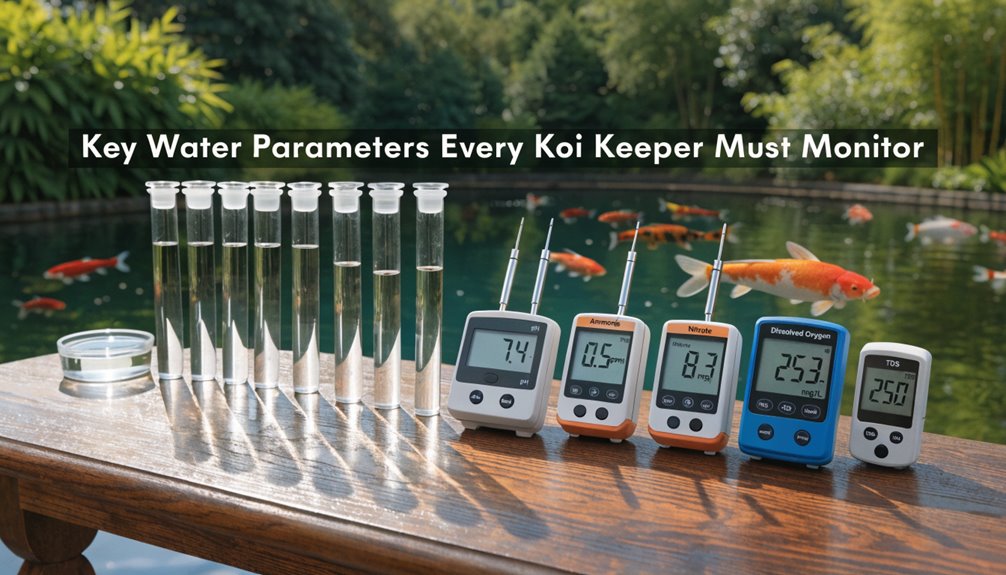
Maintaining koi health requires continuous monitoring of specific water parameters that directly affect their physiology and environment. You must maintain dissolved oxygen between 7.0–8.0 mg/L, as levels below 6 ppm impair growth, especially in warmer water above 65°F where oxygen solubility decreases. Regular monitoring of dissolved oxygen is critical, as larger fish require more oxygen to thrive. Additionally, maintaining water quality is essential to prevent stress and disease in koi.
pH should stay within 7.2–8.0, avoiding rapid shifts over 0.2 units per hour to prevent stress. Buffer capacity (KH) between 120–180 ppm stabilizes pH and supports biofilter function by neutralizing acids.
Toxic nitrogen compounds demand vigilance: ammonia and nitrite must stay near zero, while nitrate shouldn’t exceed 60 ppm to avoid toxicity.
General hardness (GH) of 150–300 mg/L supports osmotic balance and reduces physiological stress.
Consistent monitoring of these parameters ensures optimal koi health and pond stability.
How to Use the API Pond Master Test Kit for Reliable Results
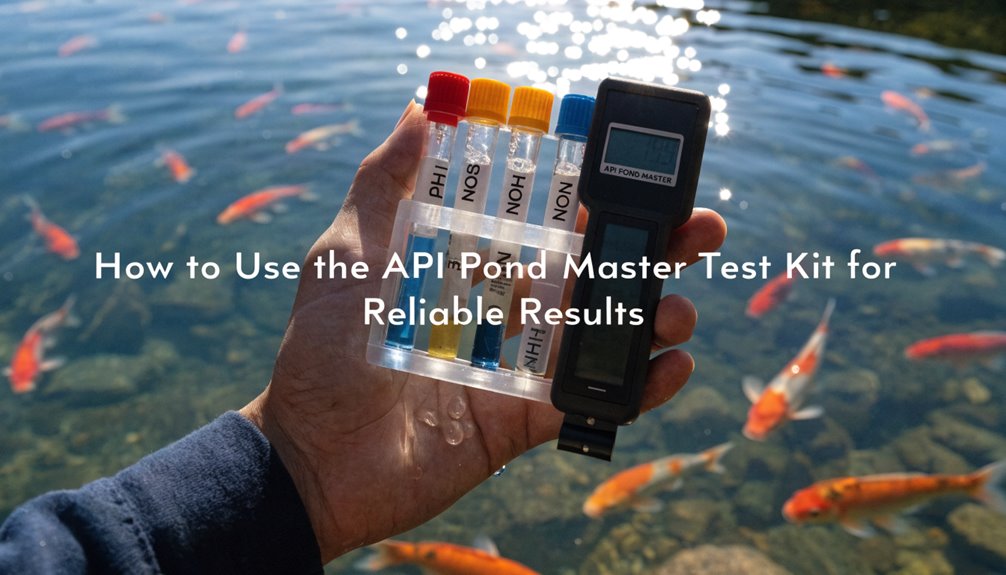
When you use the API Pond Master Test Kit, precise sample collection and reagent handling are crucial for obtaining accurate water quality readings. Start by filling four clean vials with fresh pond water, matching the meniscus to the marked line for consistency. Follow reagent addition strictly according to the instructions to ensure valid chemical reactions.
- Add reagents sequentially for ammonia, nitrite, and phosphate tests; cap and shake vials vigorously.
- For pH, choose the correct range solution and add exactly three drops without shaking.
- Allow proper color development time before comparison.
- Match vial colors with the kit’s reference charts to determine concentrations.
Consistent technique and timing in each step guarantee reliable, actionable results for maintaining optimal koi pond health. Additionally, monitoring ammonia levels is vital to prevent toxicity and ensure the well-being of your koi.
What Makes NT Labs Test Kits a Trusted Choice for Koi Ponds?
Because precise water quality monitoring is critical for koi health, NT Labs test kits stand out by offering comprehensive multi-parameter analysis tailored to pond environments. You’ll measure ammonia, nitrite, nitrate, pH, GH, and KH accurately with a single kit, reducing complexity and cost.
Their liquid drop test method ensures consistent, repeatable results, outperforming dip strips and eliminating subjective color-matching errors. The kit’s design includes standardized drop sizes, a test tube rack to prevent cross-contamination, and clear instructions for efficient workflow. Additionally, the kit provides up to 200 tests for six key parameters, offering long-term value and convenience through integrated test tube rack.
You can trust these tests across various pond types and water chemistries, from new setups to established systems. Recognized by professionals, NT Labs kits provide dependable data, enabling informed decisions to maintain optimal water parameters and safeguard koi health effectively.
How to Get Quick KH Readings With the Pon Lab Test Kit 200 for Koi Ponds
Although many test kits rely on color-chart comparisons, the NT Labs Pond Lab Test Kit 200 employs a drop-count titration method that delivers quick, numeric KH (carbonate hardness) readings for koi ponds.
You start by collecting a 5 mL pond water sample in a clean test tube, ensuring no contamination. Then, add KH reagent dropwise, swirling gently after each drop to mix thoroughly. The endpoint occurs when the sample shifts from colorless to yellow, which you identify against a white background. The number of drops corresponds directly to the KH value in °dH. Only JBL provided a KH testing kit using this titration method, which proved accurate by counting drops for KH measurement.
Follow these steps for accurate and rapid results:
- Use a clean test tube rinsed with pond water.
- Add reagent drops slowly, swirling after each.
- Count drops until consistent yellow appears.
- Record the drop count as your KH value.
Comparing Basic and High-Range PH Tests for Koi Ponds
Accurate KH readings set a foundation for maintaining stable water chemistry, but monitoring pH levels demands equal attention to support koi health. Basic pH tests, like the API Kit, offer precise readings within the typical 6.8 to 7.5 range, using clear glass vials for exact color matching and delivering over 720 tests per kit—a cost-effective choice for standard ponds. Consistent water quality management is essential for healthy koi and vibrant colors.
However, high-range tests, such as NT Labs, extend pH measurement up to 10 mg/l, crucial for ponds with alkaline supplementation or mineral-rich water. These kits provide clear incremental color variations and eco-friendly packaging, enabling comprehensive monitoring.
Unlike strip tests, liquid dropper kits ensure chemical precision unaffected by environmental factors, making them essential for serious koi keepers managing both typical and atypical pond chemistries.
How to Detect Ammonia and Nitrite Levels Effectively
When you monitor ammonia and nitrite levels closely, you can prevent toxic buildups that threaten koi health. Using precise detection methods is critical to maintaining safe water chemistry. Digital photometers like the Exact iDip offer high sensitivity, measuring ammonia as low as 0.01 mg/l and nitrite down to 0.07 ppm, eliminating human error with direct numerical readouts. The Exact iDip connects directly to smartphones via Bluetooth, allowing easy storage and sharing of test results through its dedicated app for mobile device integration. Accurate pond volume measurement is essential for determining proper treatment dosages for ammonia and nitrite. Continuous monitors, such as Seneye, provide real-time alerts, allowing immediate response to dangerous spikes. Traditional reagent test kits remain useful but require careful sample prep and subjective color interpretation. 1. Use digital photometers for accurate, multi-parameter analysis. 2. Employ continuous monitors for real-time ammonia and nitrite tracking. 3. Apply reagent test kits carefully to avoid errors. 4. Calibrate devices against pond water to ensure reliable readings in all conditions.
How to Use Phosphate Tests to Prevent Algae Problems
Because phosphate acts as a key nutrient fueling algae growth, you must monitor its concentration carefully to prevent blooms in your koi pond. Use a reliable phosphate test kit—collect 5 ml of pond water, add reagent drops, mix gently, and wait five minutes for color development. Phosphate is a major nutrient in fish food that supports growth and bone formation, and excess nutrients can significantly exacerbate algae issues.
Compare the color to the chart within 30 seconds for accuracy. Aim to keep phosphate levels below 0.05 mg/L for optimal control; anything above 0.3 mg/L signals a risk of algae proliferation.
Regular weekly testing helps detect spikes from feed, decaying matter, or tap water. If elevated, perform partial water changes with dechlorinated water tested for phosphate.
Consider phosphate-binding treatments or reduce feed protein to cut phosphate inputs.
Consistent monitoring and timely action form your best defense against algae problems.
Why GH and KH Hardness Matter for Your Pond
Monitoring phosphate levels helps prevent algae growth, but maintaining proper water hardness also plays a key role in pond health. GH (general hardness) measures calcium and magnesium ions essential for koi osmoregulation and skeletal development.
KH (carbonate hardness) buffers pH, preventing harmful fluctuations. It is also essential for the survival of nitrifying bacteria that remove toxic ammonia and nitrite, supporting effective biological filtration and overall pond health. Carbonate Hardness Importance
Consider these critical points:
- KH stabilizes pH by neutralizing acids from the nitrogen cycle, preventing lethal pH crashes.
- GH supports fish physiological functions and must be maintained to avoid deficiencies affecting scales and bones.
- KH below 100 ppm weakens buffering capacity; target 150–200 ppm for stability, especially with bead filters.
- Regular testing ensures hardness levels remain optimal, facilitating a resilient environment for koi and beneficial bacteria.
Proper GH and KH management sustains water chemistry balance crucial for koi health.
How Salt Concentration Affects Koi Health and Testing Methods
Although koi thrive in freshwater, maintaining appropriate salt concentrations in their environment significantly impacts their health and recovery. You should aim for therapeutic salt levels between 0.3% and 0.6%, balancing parasite control and kidney workload reduction.
Salt supplementation reduces osmotic stress by aligning external salinity closer to the koi’s internal 0.9% blood salinity, easing osmoregulatory demands and improving gill function. It also enhances mucous slime coat production, supporting better fish health and defense against pathogens.
Sudden salt increases effectively disrupt parasite osmoregulation, targeting organisms like Glossatella and Trichodiniids, while gradual rises reduce efficacy.
Using precise salinity test kits lets you monitor and adjust salt concentrations, ensuring optimal stress reduction, slime coat enhancement, and accelerated post-transport recovery.
Regular salt testing during seasonal transitions helps preempt disease outbreaks, maintaining pond health and koi resilience.
Specialized Test Kits for Free Ammonia and Microbiological Hazards in Koi Ponds
When you manage koi ponds, detecting free ammonia and microbiological hazards with specialized test kits is crucial for maintaining water quality and fish health. Liquid reagent kits like API’s provide precise free ammonia measurements via color-matching, outperforming strip tests prone to environmental errors.
Monitoring ammonia and nitrite at zero mg/l confirms microbiological safety, while phosphate and KH tests indicate secondary contamination and buffering capacity. Regular testing is essential to prevent adverse conditions that can harm aquatic life and ensure a balanced pond ecosystem importance of pond water testing.
Key points to consider:
- Use liquid dropper kits (API, NT Labs) for micro-increment ammonia detection up to 10 mg/l.
- Confirm zero ammonia and nitrite levels to rule out harmful bacterial colonization.
- Include phosphate and KH tests for comprehensive microbiological environment analysis.
- Prefer kits with durable glass vials and reusable packaging for accuracy and longevity.
Tips for Collecting Accurate Water Samples
To ensure reliable water quality data, you must collect samples from appropriate locations within the pond, avoiding edges, surface debris, and stagnant zones. Target the deepest spot or specific zones related to water use, such as feeding or irrigation areas.
Submerge containers 6 to 12 inches below the surface or midway in the water column, opening them underwater to prevent air contamination. Use the triple rinse method to eliminate residual contaminants inside bottles. When collecting near the bottom, be careful to avoid disturbing sediment to prevent contamination from resuspended particles (avoid sediment disturbance).
Collect multiple samples from various points, positioning upstream in flowing water to avoid sediment disturbance. Maintain at least one inch of headspace in containers for sealing and preservation.
Store samples cold and dark, and submit them promptly to the laboratory. These steps ensure representative, uncontaminated samples critical for accurate water quality assessment.
Troubleshooting Common Accuracy and Interpretation Issues in Pond Test Kits
Accurate water testing hinges on precise execution and reliable reagents, yet common pitfalls often undermine results. To troubleshoot accuracy and interpretation issues, focus on these critical factors:
- Reagent Integrity: Always verify expiration dates and store reagents in controlled environments to prevent degradation and contamination that skew results.
- Procedure Adherence: Follow instructions meticulously—mix reagents well, count drops precisely, and observe exact wait times to ensure correct chemical reactions. For example, waiting five minutes after mixing reagents is essential for accurate ammonia and nitrite readings, as emphasized in specific testing procedures.
- Test Kit Selection: Prefer liquid dropper kits over strip types, as strips are vulnerable to environmental influences and subjective color interpretation errors.
- Result Verification: Cross-verify readings with alternative methods or electronic testers, ensuring devices are regularly calibrated to avoid misleading adjustments. It is also critical to ignore manufacturer safe level guidelines and understand that zero ammonia and nitrite are the only safe toxin levels for koi fish health.
Maintaining Consistent Testing Schedules for Stable Water
Although establishing a reliable baseline requires comprehensive initial testing, maintaining consistent schedules is crucial for detecting fluctuations and ensuring stable water conditions.
You should adjust testing frequency based on pond maturity and seasonal changes—weekly during startup phases to monitor ammonia spikes, then bi-weekly or monthly once stability is achieved. For most water gardens and koi ponds, the API Pond Master Test Kit is recommended due to its comprehensive testing capabilities.
Focus on critical parameters: ammonia, nitrite, nitrate, KH, and phosphate, as their trends reveal nitrogen cycle health, pH buffering capacity, and algae risks.
Utilize color-coded charts and written logs to track data systematically, enabling trend analysis and correlation with treatment outcomes.
Regular, scheduled testing prevents reactive management, allowing you to proactively adjust dosing and maintain optimal water chemistry, ensuring koi health and ecosystem balance throughout seasonal transitions.
Choosing the Best Test Kit for Your Pond
When selecting a test kit for your koi pond, you need to balance precision, ease of use, and comprehensive parameter coverage. Liquid kits offer detailed chemical analysis but require more time, while digital meters provide rapid, accurate readings at a premium cost. Test strips are user-friendly for routine monitoring but less precise. Specialized kits address specific needs like high-range pH or hardness.
Consider these factors:
- Parameter coverage: Ensure ammonia, nitrite, nitrate, pH, GH, and KH testing. Regular testing maintains balanced pond chemistry, which is crucial for healthy fish and a stable ecosystem.
- Accuracy: Digital photometers outperform strips and liquid kits in precision.
- Cost efficiency: Liquid kits have lower per-test costs; digital devices reduce consumables.
- Usability: Match kit complexity to your expertise and frequency of testing.
Choose a kit that fits your technical needs and budget for effective pond management.
When and Why to Test Water During Seasonal Pond Maintenance
Selecting the right test kit lays the groundwork for effective water monitoring throughout the year, but knowing when and why to test during seasonal pond maintenance optimizes koi health and pond stability.
In spring, conduct a comprehensive baseline analysis—pH, ammonia, nitrite, phosphate—before introducing koi, guiding corrective treatments post-winter dormancy.
Throughout the active season, regularly test pH, ammonia, nitrite, nitrate, and water hardness to detect toxic accumulations and maintain nitrogen cycle balance amid rising temperatures. Using specialized equipment like the Koi Medic Salt Meter helps maintain appropriate salt levels essential for koi health.
Prioritize ammonia spikes with “Free Ammonia” tests in new setups and use high-range pH kits where applicable.
Before winter, assess water stability and toxin presence to adjust feeding, filtration, and aeration strategies, ensuring koi survival during reduced biological activity.
Consistent testing identifies instability early, preventing health crises and enabling targeted interventions.
How to Read and Interpret Color-Coded Test Results
Because accurate water quality assessment hinges on precise color interpretation, understanding how to read and interpret color-coded test results is essential for koi keepers. You must compare each test strip pad to the specific color chart supplied, within 10–15 seconds, under consistent natural light to avoid color distortion.
Follow these steps:
- Match each parameter’s pad (pH, ammonia, nitrite, nitrate) to its corresponding color block on the chart.
- Hold the strip level and avoid glare or shadows; don’t view it at an angle or too close.
- Gently shake or blot excess water once to prevent dilution or smearing of colors.
- Interpret the palest color as “0” or “non-detect,” indicating safe or minimal levels.
Adhering to these protocols ensures precise, repeatable readings critical for koi health.
Where to Buy Quality Koi Pond Test Kits and Supplies
Understanding how to accurately read water test results is only part of effective koi pond management; obtaining reliable testing equipment is equally important.
For precise readings, focus on vendors offering liquid dropper kits like Aquarium Pharmaceuticals (AP) Pond Care, favored for accuracy and resistance to environmental variables.
Retailers such as Kodama Koi Supply, Hanover Koi Farms, and Play It Koi provide pond-specific liquid and digital test kits covering ammonia, nitrite, nitrate, pH, and KH.
You can also explore The Pond Guy and Pond Warehouse, which supply comprehensive kits and advanced meters designed for serious hobbyists.
Avoid strip-type kits due to their inconsistency and sensitivity to storage conditions.
Many suppliers support bulk orders and kit bundling, reducing costs and simplifying procurement for frequent testers.
Prioritize specialist vendors over generic aquarium retailers to ensure suitability for koi pond chemistry.
Frequently Asked Questions
How Should I Store My Water Testing Kits for Longevity?
You should store your water testing kits in cool, dark, airtight containers to prevent temperature fluctuations, humidity, and light exposure. Keep them organized by expiration dates, avoid contamination, and maintain consistent environmental conditions to preserve reagent accuracy and longevity.
Can I Use Test Kits for Both Ponds and Aquariums Interchangeably?
You can’t use pond and aquarium test kits interchangeably; their measurement ranges and parameters differ due to environment-specific variables. Like a knight wielding a sword, you need the right tool for accurate, reliable water chemistry analysis.
What Safety Precautions Should I Take When Handling Test Chemicals?
You should always wear gloves and eye protection, handle chemicals carefully to avoid spills, store reagents away from heat and sunlight, label solutions clearly, use proper disposal methods, and keep first aid supplies nearby for emergencies.
How Often Should I Replace Expired Test Solutions or Strips?
You should replace expired test solutions every 12-24 months and test strips every 6-12 months. Always follow manufacturer guidelines, store kits properly, and track opening dates to maintain accurate, reliable water parameter readings.
Are There Smartphone Apps to Help Track and Log Test Results?
Think of your pond as a ship; unfortunately, no dedicated koi apps steer it perfectly. You’ll find generic aquarium apps, but they lack koi-specific metrics. Instead, use spreadsheets or photo logs for precise, customizable data tracking and analysis.
Conclusion
Accurate water testing is essential since even a 0.2 mg/L spike in ammonia can stress koi, increasing disease risk by 30%. Using reliable kits like API Pond Master or NT Labs ensures precise monitoring of critical parameters such as pH, KH, and ammonia. Regular testing, especially during seasonal changes, helps you maintain optimal water quality. By choosing the right test kit and understanding results, you’ll protect your koi’s health and longevity with data-driven decisions.