You should use thick, durable bags—ideally 3-4 mil polyethylene—with proper sizing to suit your koi, typically 36 inches or longer for larger fish. Double or triple bagging prevents leaks and punctures, while filling bags one-third with water and two-thirds with oxygen ensures safety. Pair bags with insulated, padded containers like Styrofoam coolers or polystyrene boxes to maintain temperature and protect against shocks. Understanding bag thickness, water conditioning, and secure sealing will help keep your koi safe during transport.
Key Facts Summarized
- Use thick, durable plastic bags (3-4 mil) with double or triple bagging to prevent punctures and ensure koi safety during transport.
- Select bags sized to fit koi comfortably, filling with one-third water and two-thirds oxygen to maintain optimal conditions.
- Employ insulated Styrofoam coolers or polystyrene boxes with padding and ice packs to stabilize temperature and protect bags.
- Inject pure oxygen into bags and use diffusers or aeration devices in tanks for extended transport times and improved water quality.
- Choose large, sturdy containers at least 4 inches longer than koi, ensuring secure sealing and minimizing handling stress.
Why Proper Koi Transport Bag Selection Ensures Fish Safety
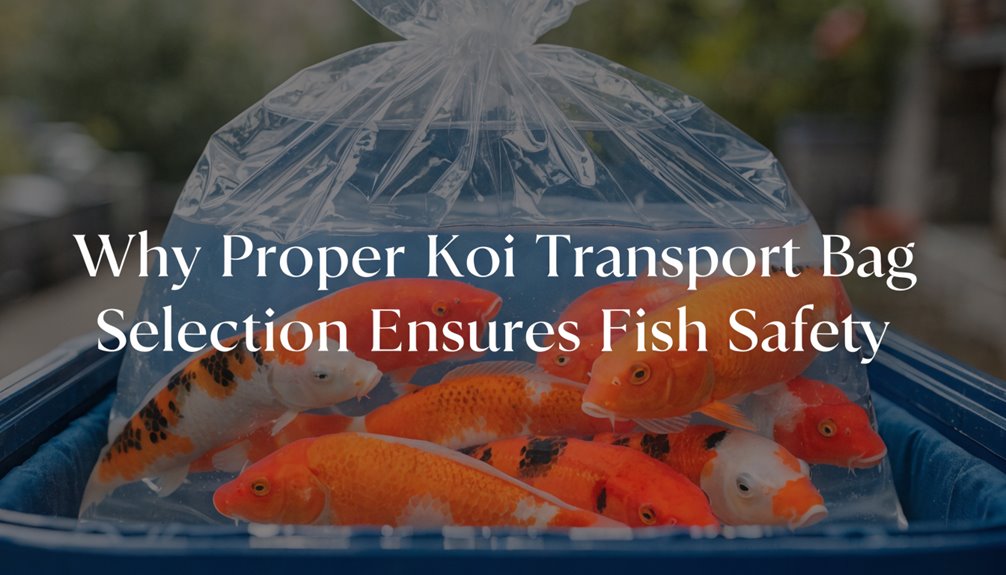
When transporting koi, selecting the right transport bag is crucial to ensure your fish’s safety and well-being. Your koi must be covered by water at least 90% to prevent stress and physical harm.
Using bags with 3-4 mil thickness reduces puncture risks, and opting for double or triple bagging enhances protection, especially on longer trips. Additionally, ensuring proper sizing of your transport bags helps maintain optimal water conditions throughout transit.
Incorporating pure oxygen injection extends safe transport time to 24-35 hours by maintaining adequate oxygen levels, which prevents stress-related complications. For shorter distances, battery-operated air pumps provide sufficient aeration, but without oxygen supplementation, safe transport drops to 5-6 hours. It is also important to fill bags with salt and water conditioners prior to adding koi to reduce shock and improve water quality during transport packing procedures.
Proper bag material durability and oxygen management directly influence koi health, minimizing physical damage and ensuring stable respiration throughout transit. Prioritize these factors to secure your koi’s optimal condition during transport.
How to Choose the Best Bag Size Based on Your Koi’s Size
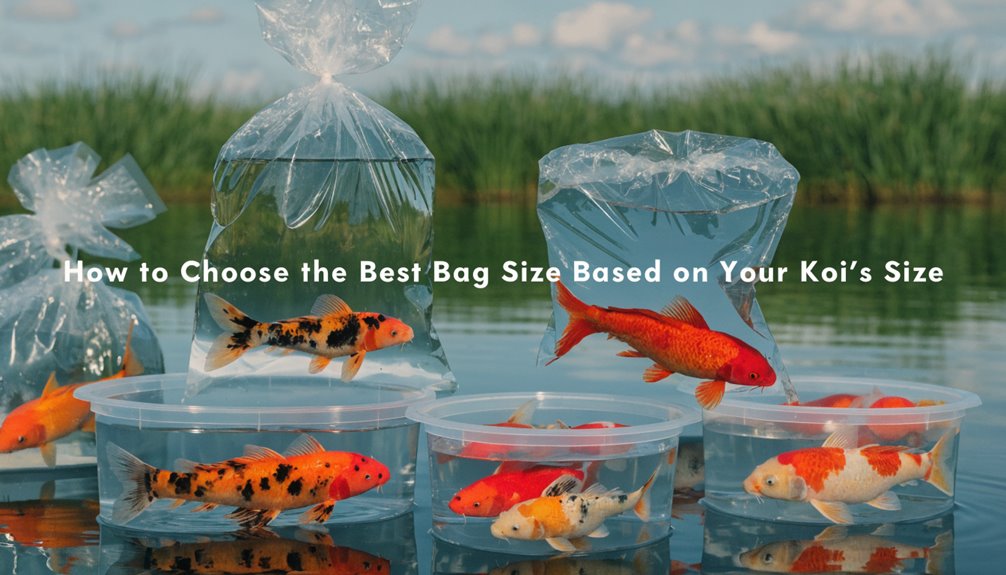
Although selecting the correct bag size may seem straightforward, it requires careful consideration of your koi’s length and oxygen needs to ensure safe transport. You must choose a bag significantly longer than the fish to allow space for water and air, as the usable length shortens once sealed. Larger koi demand bigger bags for adequate oxygen and waste dilution, which is essential for maintaining optimal water quality during transport.
Follow these guidelines:
- Select bags at least 36 inches long for larger koi, ensuring room to move and breathe. It is also recommended to use multiple bags together for added security during transport.
- Fill one-third of the bag with water, leaving two-thirds for oxygen.
- Avoid overfilling to prevent oxygen depletion and stress.
- Ensure the bag fits comfortably inside your transport container for secure sealing.
This method ensures your koi’s health and safety during transit.
Comparing Transport Bag Sizes: 20″ X 48″ vs. 20″ X 60″
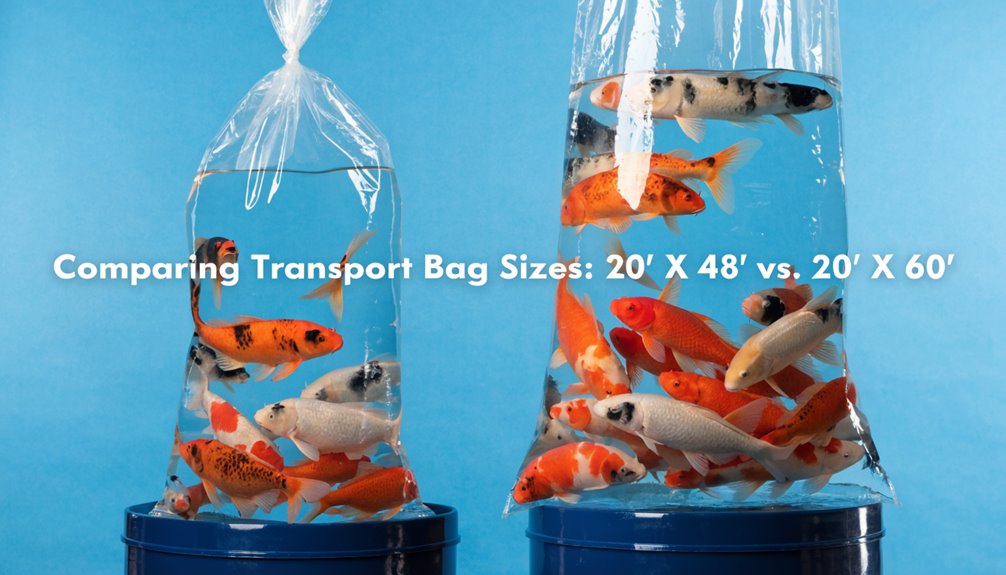
Selecting the right bag size for your koi depends largely on the fish’s length and transport duration.
The standard 20″ x 48″ bag suits koi up to 24 inches, fits standard 12″ x 12″ x 28″ shipping boxes, and holds enough water for up to 24-hour trips. Its 3-4 mil thickness balances durability and flexibility, making it widely available and cost-effective.
In contrast, the extended 20″ x 60″ bag, typically 4 mil or thicker, accommodates jumbo koi and provides increased water volume ideal for longer transports. However, it won’t fit standard shipping boxes and requires custom containers, adding complexity and cost.
Oxygen requirements remain similar, but the larger bag’s increased surface area aids oxygen retention. Ensuring water quality and temperature is crucial during transport to maintain koi health.
Choose based on koi size, transport time, and shipping box compatibility to ensure safe, efficient koi transport.
When to Use Double or Triple Koi Transport Bagging?
Because koi transport involves risks like fin punctures and water leakage, using double or triple bagging techniques significantly enhances protection. Double bagging serves as your baseline defense, minimizing fin damage and preventing leaks by creating redundancy. Overpopulation can lead to harmful gas and chemical buildup in the transport environment, making safe handling even more crucial.
You’ll want to triple bag when transport exceeds 6–8 hours or involves multiple handling points, as this adds a critical third barrier against leaks and punctures.
Consider these factors when choosing your bagging method:
- Transport duration: use triple bagging for extended moves beyond 8 hours.
- Koi size and activity: larger, active fish increase puncture risk, favor triple bagging.
- Number of fish: overcrowding demands individual double-bagged units for stress reduction.
- Waste management: multiple bags help maintain oxygen by limiting waste buildup impact.
Always ensure that bags and coolers are large enough for koi to stay relaxed and unbent during transport.
Use this approach to optimize koi safety during transit.
How Bag Thickness Affects Durability and Leak Prevention
When transporting koi, bag thickness plays a crucial role in preventing leaks and ensuring durability. You should use bags with at least 3 mil polyethylene thickness, the industry standard, to resist punctures from dorsal fin rays and fish movement. Thicker bags reduce tear risks, especially for journeys exceeding 6 hours. Overinflation increases puncture vulnerability, so moderate inflation is key. Additionally, maintaining healthy habitats is vital for the well-being of koi, making safe transport equally important. Double-bagging compensates for thinner materials by providing redundancy. The bags made from leak-resistant metallocene resin polyethylene are designed to withstand transport rigors, enhancing their durability.
| Thickness (mil) | Durability Impact |
|---|---|
| 1-2 | Insufficient, prone to tears |
| 3 | Standard, balances strength and flexibility |
| 4-5 | Enhanced resistance for long transports |
| >5 | Heavy-duty, minimal leak risk |
| Double Bagging | Adds redundancy, offsets thin bags |
Selecting appropriate thickness safeguards your koi effectively.
Why Pure Oxygen Matters for Safe Koi Transport
Although transporting koi in sealed bags limits water volume, it rapidly depletes oxygen levels unless you supplement with pure oxygen. Pure oxygen contains 100% O₂, compared to ambient air’s 21%, providing nearly five times the oxygen supply. This supplementation is crucial because stressed koi consume oxygen faster, and without it, safe transport time caps at about one hour.
When you use pure oxygen, consider these factors:
- Maintain flow rates of 3–6 liters per minute per 100 gallons to keep dissolved oxygen stable.
- Avoid excessive agitation to minimize carbon dioxide buildup, which can harm koi over time.
- Use pure oxygen to reduce nitrogen-related gas imbalances in closed systems.
- Expect a 25% increase in loading capacity due to improved oxygen availability.
Supplementing with pure oxygen reduces stress, supports immune function, and prevents lethal oxygen deprivation during transport. Ensuring proper oxygenation during transport also helps prevent disease and keeps koi comfortable and healthy.
How Water Conditioner Protects Koi During Transport
If you want to safeguard your koi during extended transport, using a high-quality water conditioner is essential. Conditioners neutralize ammonia from fish waste, preventing toxic buildup in sealed bags where koi metabolism accelerates waste production. They also stabilize pH by counteracting carbon dioxide–induced acidification, maintaining a chemically stable, stress-reducing environment. Preparing all equipment, including water conditioner, well in advance is part of the meticulous planning required for successful koi transport proper preparation.
Complete conditioners simultaneously remove chlorine, chloramine, and metals, ensuring water sourced from unknown supplies is safe. Apply precise doses before adding koi to establish a protective baseline.
Conditioned water, combined with temperature control, slows koi metabolism, reducing oxygen demand and ammonia excretion. By maintaining chemical stability and preventing rapid environmental shifts, conditioners minimize physiological shock, supporting koi health throughout transport.
Proper pre-transport water preparation maximizes conditioner effectiveness, making it indispensable for safe koi relocation.
How Salt Concentration Helps Koi Stay Healthy in Bags
Water conditioners help stabilize the chemical environment inside transport bags, but maintaining the proper salt concentration plays an equally important role in supporting koi health during shipment.
Salt at 0.3% to 0.5% concentration reduces osmotic stress by balancing electrolyte levels, allowing koi to conserve energy for immune responses rather than osmoregulation. This also minimizes parasite loads and bacterial infections by creating unfavorable osmotic conditions for pathogens.
To optimize koi health during transport, consider these key points:
- Use non-iodized aquarium or sea salt without additives to maintain water quality.
- Initiate salt addition at transport start to reduce stress immediately.
- Maintain salt levels throughout shipping and quarantine for continuous protection, as salt supports gill function improving oxygen regulation.
- Adjust salt concentration post-transport with gradual freshwater acclimation to ensure recovery and survival.
Best Practices for Securing Koi Transport Bags With Rubber Bands
When securing koi transport bags, selecting the right rubber bands is crucial to maintaining a reliable seal throughout transit. Use heavy-duty, industrial-strength rubber bands to prevent breakage caused by twisting the bag’s neck tightly into a gooseneck seal. Apply at least two wraps around the folded neck and position bands off-center for easy removal. Double-banding adds redundancy and reduces accidental openings. It is also important to avoid over-tightening to maintain bag integrity and koi safety during the journey.
| Step | Key Practice |
|---|---|
| Band Selection | Use heavy-duty, elastic bands |
| Gooseneck Formation | Twist neck tightly, fold over |
| Band Application | Wrap bands twice, place off-center |
| Redundancy | Double-band inner and outer bags |
Prepare extra bands for replacement mid-transport and avoid over-tightening to maintain bag integrity and koi safety.
How to Choose Durable Boxes and Coolers for Transport Bags?
Securing your koi transport bags properly sets the foundation for safe shipment, but selecting the right boxes and coolers ensures the bags remain protected and maintain stable conditions throughout the journey. You want containers that provide insulation, structural integrity, and comply with commercial shipping standards.
Consider these key factors:
- Material: Styrofoam coolers offer superior insulation; pair them with cardboard boxes for external protection and shipping compliance.
- Size: Choose boxes at least 4 inches longer than your largest koi, allowing double-bagged fish to lie comfortably side by side without contact. It is also important to ensure the container is large enough to prevent koi from bouncing or moving excessively during transport, which can cause stress or injury container size.
- Protection: Ensure container walls withstand handling, with extra padding to prevent punctures and deformation.
- Temperature Control: Use ice packs inside coolers (not bags) and add insulating layers to minimize temperature fluctuations during transit.
This approach safeguards your koi and meets professional shipping requirements efficiently.
Step-by-Step Guide: How to Pack a Koi Transport Bag
Before you begin packing your koi transport bag, set up a clean, organized workspace where the bag is fully opened and ready.
Ensure oxygen delivery is functional and place the transport container nearby to minimize koi movement. Aeration with air pumps helps maintain oxygen levels in transport tanks or bags, which is crucial for the koi’s survival.
Gently guide the koi to a corner without chasing; use a bowl and a second person to calm the fish during transfer.
Avoid lifting the koi out of water.
Fill the bag with pond water, just enough to cover the fish, maximizing oxygen volume.
Use strong PVC bags and double bag them, adding a small water volume inside the inner bag to allow it to sink fully.
Roll both bags down about ¼ their length to form a cuff, then secure the top with rubber bands to prevent leaks.
How to Extend Transport Time Using Oxygen and Bagging Methods
Extending the safe transport time of your koi hinges largely on optimizing oxygen levels and employing effective bagging methods. To maximize survival time, consider these critical steps:
- Inject pure oxygen into transport bags to maintain dissolved oxygen, enabling safe transport for up to 35 hours compared to 5-6 hours with regular air.
- Use double bagging at minimum; triple bagging significantly lowers leakage and puncture risks, ensuring containment integrity. For larger koi, triple bagging is often necessary to provide the added security required during transport.
- Select proper bag sizes that accommodate multiple layers without compromising fit inside transport containers.
- Employ supplemental oxygen sources like pure oxygen tanks for long hauls or battery-operated pumps for shorter trips, adjusting your method based on transport duration needs.
When to Consider Alternative Koi Transport Tanks?
When transporting koi larger than 24 inches or planning journeys exceeding 24 hours, you should consider using alternative transport tanks instead of traditional bags. Large koi surpassing standard bag capacities require tanks to prevent compression injuries and reduce stress.
Tanks provide greater water volume, ensuring stable oxygen levels, temperature control, and water quality over extended durations. If you’re moving multiple koi simultaneously or handling high-value specimens, tanks minimize physical damage risks and simplify handling. While bags are designed to transport Koi safely and securely, their limited size and quantity per box make them more suitable for shorter trips or smaller fish.
Bags, limited to about 24 hours without supplemental oxygen, pose leakage and thrashing hazards for larger fish. Economically, tanks are reusable and preferred by professionals, while rental options offer cost-effective solutions.
Ultimately, choosing tanks over bags enhances koi welfare during prolonged or large-scale transports, making them the superior method for demanding koi relocation scenarios.
How to Set Up a Transport Tank With Oxygen and Air Pumps
Although setting up a transport tank might seem straightforward, ensuring proper oxygenation and aeration requires careful attention to equipment and configuration. You’ll need to balance oxygen supply, water volume, and aeration methods precisely.
Follow these key steps:
- Use insulated polystyrene boxes with appropriately sized heavy-duty plastic bags, securing them tightly to prevent oxygen loss.
- Connect a single-stage pressure regulator and flow meter to a pure oxygen tank for controlled oxygen delivery, especially on trips over one hour.
- Install fine-pore diffuser stones or medium/coarse-pore diffusers at the tank bottom for optimal oxygen dispersion.
- Employ battery-powered air pumps or agitators to maintain water circulation and provide backup aeration during transport emergencies.
This setup ensures stable oxygen levels and fish safety throughout transit.
How to Maintain Water Quality in Koi Transport Tanks
Maintaining optimal water quality during koi transport demands rigorous monitoring and control of several chemical parameters. You must ensure pH stays between 7.0 and 8.0—ideally 7.5 to 7.7—and ammonia levels remain near 0 ppm to prevent gill damage.
Test water for ammonia, nitrite, nitrate, carbonate hardness, salinity, and pH before loading. Use dechlorinated water, either pond-sourced or treated tap water with effective conditioners like AmQuell+. Good filtration and aeration in transport containers help sustain water quality and fish health during transit.
Withhold feeding for five days before transport to reduce ammonia excretion. Maintain lower water temperatures to slow ammonia buildup and pH fluctuations.
Establish beneficial bacteria colonies to support nitrogen cycling, keeping nitrites close to 0 mg/L and nitrates under 20 mg/L.
Regularly test water during transit and avoid cross-contamination by using disinfected equipment and preventing water mixing between transport tanks and destination ponds.
Tips to Minimize Koi Stress During Transport
To minimize koi stress during transport, you need to focus on pre-transport conditioning, gentle handling, and maintaining stable environmental conditions. Proper acclimation to water chemistry and withholding feed 24–48 hours before packing reduce metabolic waste and physiological shock.
Handle koi with soft nets, minimizing air exposure to under 20 seconds, and keep their bodies fully supported in water. Environmental stability during transit—avoiding temperature fluctuations, vibration, and sudden light changes—further reduces stress.
- Acclimate koi gradually and limit handling to avoid cortisol spikes.
- Use knot-free nets and transfer koi directly to bags, keeping them submerged.
- Transport in opaque, insulated containers shielded from noise and vibration.
- Drive cautiously to prevent abrupt movements that can injure koi.
Balancing Bag Size and Box Closure for Secure Transport
When selecting transport bags for your koi, you need to balance the bag size carefully to ensure secure closure within the transport box. Choose a bag length matching your koi’s size—48″ for medium, 54″ for large, and 60″ for maximum-sized fish—while maintaining a standard 20″ width.
Oversized bags prevent proper box sealing, risking contamination and damage, whereas undersized bags limit twisting space for secure knots and rubber band closure. Ensure the bag allows at least 90% submersion of your koi with sufficient water volume for oxygen saturation, avoiding excess air pockets.
The bag must fit entirely within the box without compression, enabling lid closure and protecting the fish from impact. Proper sizing guarantees stable oxygen levels and secure containment during transport, optimizing koi safety.
Troubleshooting Common Issues With Koi Transport Bags
Although koi transport bags are designed for durability and safety, several common issues can compromise their effectiveness during transit. To troubleshoot effectively, focus on these critical areas:
- Puncture and Leakage: Use double or triple-bagging with thick-gauge plastic (3-4 mil minimum) and partially inflate bags to resist punctures. Secure elastic bands tightly and verify zipper seals thrice before departure.
- Oxygen Depletion: For trips over 4-6 hours, employ portable air pumps or oxygen tanks. Maintain a one-third water to two-thirds oxygen ratio and consider oxygen tablets as a backup. Overcrowding increases stress and reduces oxygen availability, so transport koi in small groups with sufficient space.
- Temperature Management: Match water temperature to the source pond, use insulated containers, and separate ice packs from bags to avoid thermal shock.
- Water Quality: Utilize dechlorinated water, add salt and conditioners, and avoid mixing transport water with the destination pond to prevent toxicity and infection. Preparing fresh, conditioned water that matches the original tank’s parameters helps maintain water quality during transit.
Frequently Asked Questions
What Is the Best Way to Acclimate Koi After Transport?
You should float the bagged koi on pond water for 20-30 minutes, avoid direct sunlight by covering with a damp towel, and extend acclimation up to 60 minutes if temperature differences are large to minimize stress and osmotic imbalance.
Can Koi Be Transported Without Salt in the Water?
You can transport koi without salt, but it increases stress, ammonia toxicity, and mortality risks significantly. Salt stabilizes osmotic balance and water chemistry, so omitting it demands stringent monitoring and rapid transit to minimize physiological damage.
How Do Temperature Fluctuations Affect Koi During Transport?
Temperature fluctuations during transport stress koi like a volcano erupting, raising heart rate and metabolic demand. You’ll see immune suppression, acidosis, and potential death if changes exceed 3°C suddenly or fluctuate repeatedly. Manage temperature carefully.
Are Biodegradable Transport Bags Available for Koi Shipping?
Yes, you can get biodegradable transport bags specifically designed for koi shipping. These bags maintain durability and leak-proof integrity during transit, decompose quickly in composting facilities, and reduce environmental impact compared to traditional plastic alternatives.
What Are the Signs of Koi Distress During Transport?
You’ll spot koi distress during transport through flashing, erratic swimming, clamped fins, gasping, lethargy, skin scraping, and bloating. Watch for rapid gill movement and aggression—they indicate oxygen deficiency, infection, or severe stress requiring intervention.
Conclusion
Think of transporting your koi like securing a priceless gem in a vault—every detail matters. Choosing the right bag size, thickness, and layering is like selecting the perfect lock to prevent leaks and stress. Just as a jeweler ensures flawless packaging, you must maintain water quality and minimize stress for your fish. With precise preparation, your koi will arrive safely, thriving and vibrant, ready to flourish in their new home.