If you’re seeking top Japanese koi breeders, focus on Sakai Koi Farm’s championship legacy and Hiroshima’s rising experts specializing in jumbo Kohaku, Sanke, and Ginrin varieties. Maruyama and Momotaro Koi Farms excel in vivid coloration and large size, while Kodama and Teradomari refine metallic luster and sparkle. These breeders use rigorous selection, data-driven techniques, and advanced breeding to ensure superior koi quality. Understanding their methods and global distribution networks will deepen your insight into elite koi excellence.
Key Facts Summarized
- Sakai Koi Farm is Japan’s top breeder with 13 Grand Champion titles, known for jumbo Kohaku and data-driven quality breeding.
- Maruyama Koi Farm excels in vivid Kagura bloodline koi and jumbo Kohaku, winning multiple All Japan championships.
- Momotaro Koi Farm specializes in large, high-quality Kohaku up to 100cm, using rigorous water management and selective breeding.
- Kodama Koi Farm is renowned for metallic Kin Showa, with award-winning luster and pattern clarity sourced from 50+ Japanese breeders.
- Teradomari Koi Farm leads in ginrin Kohaku, prized for sparkle, pattern refinement, and multiple Best in Variety titles.
Why Sakai Koi Farm Leads in Championship-Quality Koi
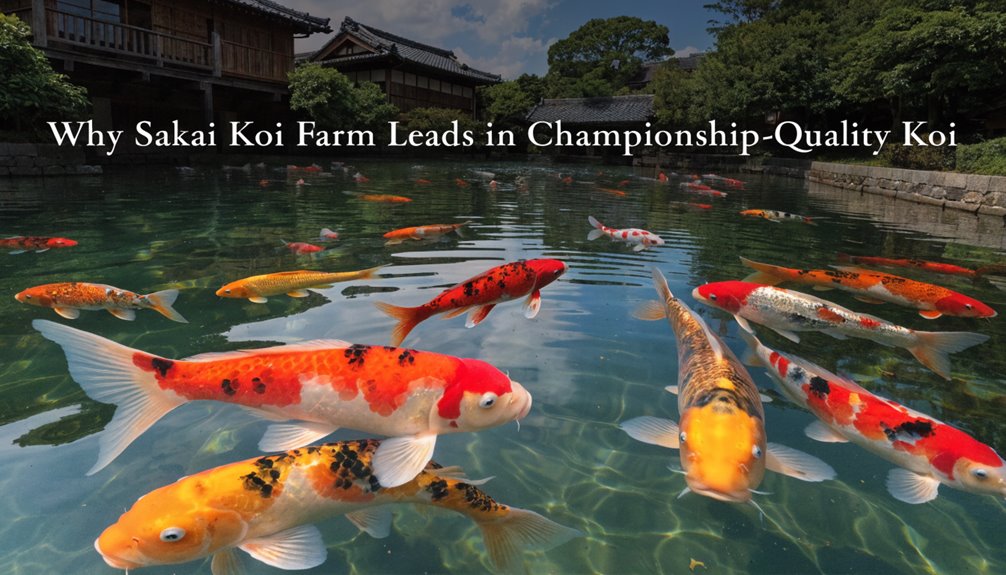
Although many breeders produce high-quality koi, Sakai Koi Farm stands out due to its unmatched historical excellence and championship dominance. Established in 1896, Sakai has secured 13 Grand Champion titles at the All Japan Combined Nishikigoi Show by 2024, more than any other breeder.
Their koi, such as the famed “S Legend,” exhibit powerful body frames, clean shiroji, and stable beni patterns, reflecting rigorous selective breeding. Additionally, proper planning in their breeding process ensures the sustainability and health of their koi.
You’ll notice their production spans 20 hectares in Hiroshima, with 80 mud ponds and 12 greenhouses enabling precise environmental control. This scale and infrastructure reflect the full-time Nishikigoi breeding operation that Sakai developed in the mid-1900s.
Sakai employs data-driven breeding, measuring individual koi weights to optimize feeding and growth. This scientific approach ensures consistent quality, long-term development, and superior sumi and beni refinement, reinforcing Sakai’s position as the industry’s leading championship-quality koi breeder.
Jumbo Gosanke Varieties: Kohaku, Sanke, and Showa Explained

Sakai Koi Farm’s mastery in breeding championship-quality koi owes much to its focus on the Gosanke varieties—Kohaku, Sanke, and Showa—each representing distinct aesthetic and genetic traits. Understanding these jumbo varieties is crucial for serious collectors.
- Kohaku features a white base with bold red (hi) markings, prized for its classic balance and dynamic color deepening with age. It’s the foundational variety in many breeding programs.
- Sanke displays a white body with red and sharply defined black (sumi) patches, emphasizing clean color separation and lacquer-like sumi quality. This variety reflects its Taisho era origins.
- Showa presents a black base interwoven with red and white, showing dynamic sumi patterns that mature over time. These patterns create dramatic contrast fundamental to its evaluation.
You’ll want to assess color purity, pattern symmetry, and skin quality to appreciate these varieties’ competitive significance fully. Additionally, understanding pattern quality is essential for evaluating Koi in competitions.
Top Niigata Breeders Specializing in Elite Kohaku Koi

When you explore elite Kohaku koi breeding in Niigata, several farms stand out for their specialized expertise and decades of refinement.
Murata Koi Farm in Uonuma produces Kohaku with brilliant white bodies and deep red markings, backed by award-winning conformation. The farm is known for its approximately 30,000 m² breeding area, which supports its high-quality koi production and utilizes premium koi foods to enhance growth and color.
Yamamatsu Koi Farm brings nearly a century of meticulous selection, maintaining consistent Kohaku quality rooted in deep bloodline knowledge.
Sakamaki Koi Farm focuses on precision pattern and color clarity, delivering Kohaku with crisp, aesthetically refined markings.
Teradomari Koi Farm pioneers Ginrin Kohaku, emphasizing metallic reflective scales and competitive show success.
Lastly, the NND Koi Farm network blends expertise from three breeders, enhancing genetic diversity and specialized selection methods.
These Niigata breeders collectively define elite Kohaku standards through technical mastery and innovative practices.
Rising Hiroshima Breeders Excelling in Kohaku and Sanke
Niigata’s established Kohaku breeding expertise sets a high benchmark that rising Hiroshima breeders are now meeting with impressive skill and innovation.
In Kawauchi, you’ll find breeders like Yoshimichi Sakai, known for multi-generational gosanke knowledge, mastering Kohaku, Sanke, and Kujaku varieties. Their proximity to competitive farms pushes quality standards higher.
Key factors driving their success include:
- Integration of Sensuke Kohaku bloodlines, enhancing color intensity and pattern consistency.
- Focused breeding programs targeting premium Kohaku and Sanke, demonstrated by multiple award-winning koi.
- Adaptation to intense regional competition, fostering continuous innovation and superior koi production.
Additionally, these breeders prioritize maintenance practices to ensure the health and vibrancy of their koi throughout their life cycles.
Why Maruyama Koi Farm Excels in Kohaku Breeding
Although many breeders have made significant strides in Kohaku development, Maruyama Koi Farm stands out due to its pioneering Kagura bloodline and innovative red pigmentation techniques.
You’ll appreciate their “Kagura-Beni” strain, which delivers vivid, glossy red coloration that sets global Gosanke standards. Their selective breeding ensures crisp shiroji and deep beni, producing show-quality Kohaku with superior color purity and high-gloss finishes.
Maruyama’s Kohaku consistently exceed 80cm, reflecting strong genetic growth potential and excellent body conformation. Their medium-scale, controlled production prioritizes quality over quantity, focusing on jumbo and Ginrin Kohaku varieties. The farm, located in Isawa, Fuefuki City, Japan, benefits from a legacy founded in the 1960s by Gensuke Maruyama, now led by his son Futoshi, ensuring generational expertise.
Championship wins, including two All Japan Grand Champion titles, validate their breeding philosophy. When you choose Maruyama Kohaku, you’re investing in a lineage renowned for genetic vigor, coloration excellence, and sustained competitive success.
Momotaro Koi Farm’s Okayama Kohaku Expertise
Since its founding in the 1960s by Toshio Maeda, Momotaro Koi Farm in Okayama Prefecture has leveraged the region’s mild climate and pristine water sources to develop Kohaku koi of exceptional size and quality.
You’ll find their Kohaku breeding excels through:
- Rigorous water quality management using unique filtration materials and balanced mineral content to optimize fish health.
- Selective breeding focused on skin quality and color depth, producing jumbo Kohaku up to 90–100 cm that achieve Superior Champion status.
- Advanced growth protocols emphasizing rapid development and overcrowding prevention, supported by high-grade feed and spacious ponds. Maintaining pond conditions is crucial for the overall health of Koi and is a practice the farm prioritizes.
The farm’s success is further supported by a rigorous selection process and patience, ensuring only the best koi are developed over years before sale.
Aokiya’s Unique Strength in Kikokuryu Koi Breeding
When you examine Aokiya’s approach to Kikokuryu breeding, it’s clear their strength lies in pioneering unique koi varieties that challenge conventional standards. They engineered the Kikokuryu by crossing Kumonryu with Platinum Ogon, achieving a rare platinum skin infused with superior sumi (black) markings through rigorous multi-stage culling. This method ensures only specimens with optimal sumi and hi (red) coloration proceed through selection, resulting in exceptional genetic consistency and market-leading quality. Starting from approximately 300,000 fry, Aokiya meticulously selects only around 30,000 to continue, demonstrating the depth of their dedication to quality.
| Stage | Focus | Outcome |
|---|---|---|
| Initial Fry | Black specimens only | Remove non-black fry |
| 1 Month Growth | Retain lacquer black | Discard gray specimens |
| Hi Development | Sumi quality priority | Maintain balance of sumi/hi |
| Variety Cross | Kumonryu x Platinum | Metallic, high-contrast koi |
| Market Impact | Competition success | Premium pricing, global reach |
Kodama Koi Farm’s Prize-Winning Kin Showa Koi
If you want to explore prize-winning Kin Showa koi, Kodama Koi Farm stands out for its exceptional breeding program. They focus on enhancing the metallic luster while preserving classic red, white, and black Showa patterns.
Their access to over 50 Japanese breeders, including Kanno Koi Farm, guarantees diverse and award-winning genetics sourced directly from Niigata.
When evaluating Kodama’s Kin Showa, consider these key points:
- Metallic sheen intensity and clarity of pattern—primary quality indicators.
- Physical specs—mature size reaches about 22 inches; females often superior.
- Show track record—multiple awards, including First Place KinGin Rin A Showa at Washington Koi Show, validate their breeding standards.
Kodama Koi Farm advises buyers to purchase shipping insurance to protect their investment during shipment.
Rely on Kodama’s expert guidance to select specimens with optimal conformation and sheen for top competition and investment value.
Teradomari Koi Farm’s Innovations in Ginrin Kohaku
Although Teradomari Koi Farm operates within the competitive landscape of Niigata’s koi breeders, it distinguishes itself through a dedicated focus on developing brilliant ginrin kohaku varieties. Founded by Kiichi Hoshino, who brings over 31 years of expertise, the farm specializes exclusively in ginrin kohaku, emphasizing enduring sparkle and refined pattern development. The farm covers approximately 30,000 square meters of breeding area, combining both mud ponds and indoor systems to optimize koi growth and staging.
Its 30,000-square-meter facility supports precise selective breeding, ensuring strong growth and consistent quality under family leadership. Teradomari’s innovations have earned the “Teradomari Ginrin” designation and four Best in Variety titles at the All Japan Nishikigoi Shows, validating its breeding philosophy.
Premium specimens, often exceeding 58 cm, command prices above $5,000 internationally. Through rigorous quality control and targeted trait selection, Teradomari remains a global pioneer in ginrin kohaku excellence.
Award-Winning Kohaku and Sanke From Hiroshima Breeders
Because Hiroshima’s climate and water quality foster vibrant skin tones and stable coloration, its breeders have gained international acclaim for producing award-winning Kohaku and Sanke varieties.
You’ll find that Sakai Koi Farm, a fifth-generation leader in Mihara, exemplifies this excellence with jumbo Kohaku and Sanke known for brilliant white skin and stable, vivid red and sumi patterns.
When evaluating Hiroshima breeders, focus on:
- Consistency of coloration and predictable growth, especially in Kohaku exceeding 90 cm with broad shoulders.
- Balanced Sanke patterns featuring sharp sumi and bright hi on pristine white backgrounds.
- Proven show records, including Grand Champion titles at All-Japan Koi Shows and other major competitions.
This precision breeding makes Hiroshima a premier source for top-tier Gosanke koi globally. The success of these breeders is supported by their practice of heavy culling, which ensures only the healthiest and most beautifully patterned koi are raised to maturity.
Global Networks Distributing Japan’s Finest Koi
While Japan remains the origin of the finest Nishikigoi, you’ll find an extensive global network ensuring these prized koi reach enthusiasts worldwide. Niigata breeders maintain decades-long partnerships with major distributors, fueling robust supply chains.
In the U.S., Kodama Koi Farm leads as the largest importer, distributing over 200,000 Niigata koi through established networks and online platforms like Koimall.com. California-based centers streamline West Coast access, employing specialized packaging to ship 200+ boxes simultaneously. The farm’s commitment to traditional values and expert care ensures the highest quality koi are delivered to customers.
European markets rely on Select Nishikigoi International, mirroring U.S. distribution models with exclusive breeder relationships. These networks enforce strict vetting for genetic quality and health, supported by professional documentation and meticulous packing protocols.
How to Choose the Right Japanese Koi Breeder
When selecting a Japanese koi breeder, you must prioritize their specialization and breeding standards to ensure you acquire fish that meet your specific aesthetic and longevity goals. Focus on three key factors:
- Breeder Specialization: Choose breeders who concentrate on your desired koi variety, such as Gosanke lines, to ensure consistent traits and color stability.
- Body Structure and Development: Evaluate body frame quality—prefer breeders enforcing rigorous culling for thick, balanced koi capable of long-term growth and health.
- Skin Quality and Color Stability: Inspect skin brightness and texture, as these indicate superior genetics and raising conditions. This is critical for vibrant, lasting coloration. Additionally, selecting koi from breeders who maintain health monitoring and quarantine practices helps prevent introducing diseases into your pond.
Frequently Asked Questions
What Water Conditions Are Ideal for Keeping High-Quality Japanese Koi?
You should maintain water between 59-77°F, pH 7.0-7.5, alkalinity 120-180 ppm, dissolved oxygen above 6 ppm, ammonia below 0.25 ppm, nitrite at zero, and nitrate under 40 ppm for optimal koi health.
How Do Koi Breeders Ensure Genetic Diversity in Their Breeding Programs?
Take Sakai Koi Farm; they ensure genetic diversity by rotating breeding stock across distinct family lines and importing specimens from multiple Japanese regions. This prevents inbreeding, maintains variation, and sustains robust, healthy koi bloodlines.
What Is the Typical Lifespan of Championship-Level Japanese Koi?
Championship-level Japanese koi typically live around 40 years, but with optimal genetics and care, they can exceed 100 years. You’ll see longevity enhanced by selective breeding, environmental factors, and rigorous health management practices.
How Often Should Koi Be Fed for Optimal Health and Color?
Like clockwork, feed your koi 2-4 times daily between 70-85°F using high-protein food. Adjust frequency and type with temperature shifts, ensuring portions eaten within five minutes to optimize health and vibrant coloration.
Are There Specific Certifications or Memberships Koi Breeders Hold?
Yes, koi breeders often hold certifications from the All Japan Nishikigoi Promotion Association, requiring approval and fees, and may possess breeder certificates verifying koi origin and lineage, ensuring breeding quality and traceability within the industry.
Conclusion
If you want koi that redefine perfection, you can’t ignore these Japanese breeders—they’re absolute legends in the koi world. From Sakai’s championship-quality giants to Teradomari’s sparkling innovations, their expertise is unmatched. Choosing the right breeder means tapping into decades of precision breeding that guarantees vibrant, healthy koi with flawless patterns. Trust me, settling for anything less is like expecting a koi to swim without water—impossible. Dive in and secure your masterpiece today!