The largest koi ever recorded is Big Girl, a Chagoi variety measuring 54 inches long and weighing 91 pounds—significantly surpassing average koi sizes of 12-24 inches and about 12 pounds. This record-setting size results from superior genetics, selective breeding, and optimized pond conditions including water quality, temperature, and diet. Achieving such growth demands meticulous environmental management and nutritional strategies. Exploring how these factors combine can reveal the full potential behind giant koi development and longevity.
Key Facts Summarized
- The largest koi ever recorded is a Chagoi variety measuring 54 inches and weighing 91 pounds.
- This koi is nearly four times longer and weighs seven to eight times more than the average koi.
- Big Girl’s size surpasses typical jumbo koi length by over 18 inches and is three times heavier than the UK’s largest koi.
- Superior genetics, optimal diet, and ideal pond conditions enabled this koi’s extraordinary growth.
- Most koi max out around 21 inches, but specialized Japanese breeding can produce koi exceeding 40 inches and 45 pounds.
Big Girl: The Largest Koi Ever Recorded
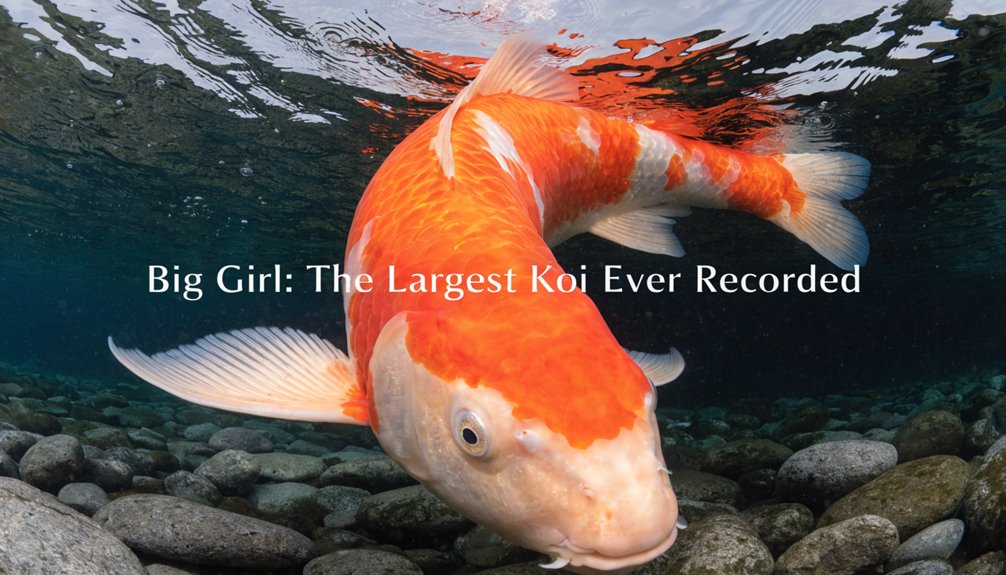
Although koi typically reach modest sizes, Big Girl defies expectations as the largest koi ever recorded, measuring 54 inches in length and weighing 91 pounds. You’ll recognize Big Girl as a Chagoi variety koi, whose physical dimensions significantly exceed standard growth parameters. Notably, the Chagoi is known for its amiable temperament, making it a popular choice among koi enthusiasts.
Documented and verified by record keepers, these measurements highlight exceptional genetic potential and environmental optimization. Owned by Geoff Lawton in the UK but originating from Japan, Big Girl thrived in a spacious pond with optimal water quality and a high-protein diet.
You can attribute her extraordinary size directly to meticulous care and superior environmental conditions. This specimen not only challenges conventional growth limits but also sets a benchmark for koi breeding and husbandry, demonstrating that koi can surpass previously accepted maximum dimensions under ideal circumstances. The genetics determine maximum potential size of koi like Big Girl play a crucial role in their ability to grow exceptionally large.
How Big Girl’s Size Compares to Average Koi
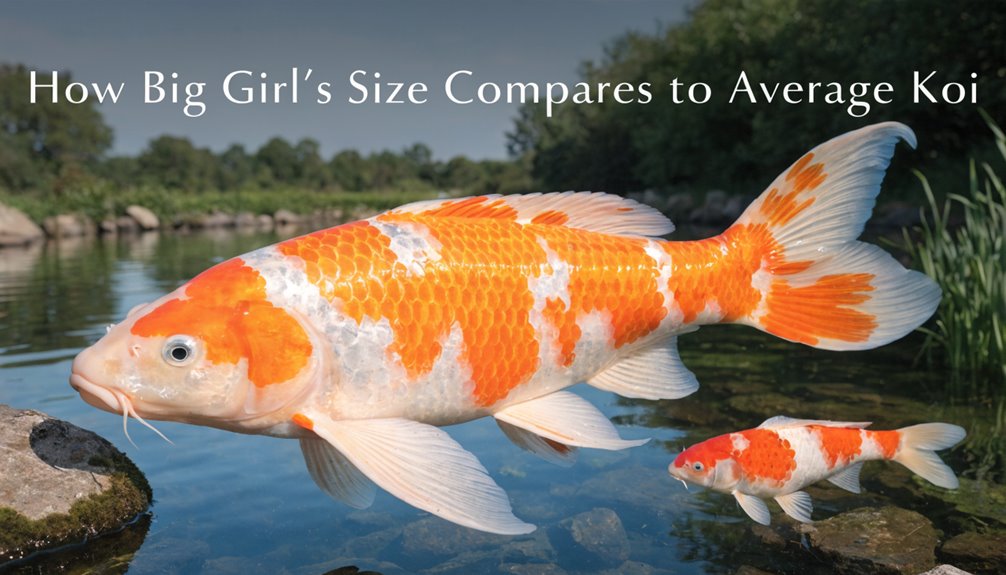
When you compare Big Girl’s size to average koi, her measurements reveal a remarkable deviation from typical growth standards. At 54 inches long and 91 pounds, she’s nearly four times the length and seven to eight times the weight of an average koi, which usually measures 12-24 inches and weighs about 12 pounds. Big Girl’s weight is also about three times larger than the biggest koi commonly found in the UK.
The ideal koi habitat design plays a crucial role in fostering such extraordinary growth.
Even compared to jumbo koi, which max out at 30-36 inches, Big Girl surpasses length expectations by over 18 inches. Her mass reflects superior growth potential enabled by optimal environmental conditions and meticulous care, unlike typical backyard koi constrained by space and resources.
This size disparity underscores the significant impact of ideal habitat and nutrition on koi development, marking Big Girl as an extraordinary outlier in the koi growth spectrum.
How Genetics and Breeding Create Giant Koi
Because genetics form the blueprint for koi growth, understanding and manipulating hereditary traits is essential to producing giant koi like Big Girl. You start by selecting koi exhibiting inherent size potential, focusing on larger females that produce bigger, healthier eggs. Maintaining optimal water quality is critical for the health of breeding stock, as it directly influences growth and vitality.
Controlled breeding tanks maintain optimal conditions—temperature between 68°F and 77°F—and precise parent selection via artificial spawning ensures desired genetic combinations. After spawning, you monitor offspring growth for three months, culling those lacking optimal traits. Koi are then sorted by color, pattern, marking, and grade to identify the most promising specimens for further growth.
By analyzing F1 and F2 generations, you track phenotype-genotype correlations to refine bloodlines. This strategic breeding, combined with high-protein feeding and controlled stocking densities, accelerates growth rates up to 3.8 cm per month. Ultimately, a rigorous genetic selection and breeding protocol creates koi capable of extraordinary size and vitality.
Why Japan’s Sakai Fish Farm Grows Giant Koi
Genetic selection sets the foundation for giant koi, but Sakai Fish Farm’s ability to grow these specimens to record sizes hinges on meticulous environmental and nutritional management.
You’ll rely on year-round strategic feeding protocols: high-protein formulas in summer maximize growth during peak metabolism, while winter diets balance growth retention and health. Feed composition averages 50% N-20 wheat-germ, 30% color-enhancing, and 20% body-enhancing nutrients, adjusted for temperature thresholds to optimize appetite and digestion.
Maintaining water temperature between 15-25°C supports metabolic efficiency; fluctuations disrupt feeding rhythms and stunt growth. Hand feeding must be approached with care to ensure koi feel comfortable and safe during feeding sessions.
You must ensure stocking density doesn’t exceed one koi per 200 gallons to minimize stress and maximize growth potential.
Advanced filtration sustains water quality by controlling pH (7.5-8.0) and removing toxins, which is critical for digestion and energy utilization, enabling koi to reach exceptional sizes.
Optimal Pond Conditions for Maximum Koi Growth
Although koi growth depends on genetics and nutrition, maintaining optimal pond conditions is critical to unlocking their full potential.
You need to maintain water temperatures between 75°F and 77°F to maximize metabolism and growth rates, ideally with year-round heating.
Keep pH levels tightly controlled between 7.5 and 8.0 and ensure efficient filtration systems remove waste while promoting beneficial bacteria to preserve water clarity and chemistry.
Aeration is essential; by saturating water with oxygen, you enhance digestion and energy utilization, accelerating growth. Maintaining good water quality is vital, as poor water conditions cause stress and reduce feeding efficiency, ultimately slowing growth rate.
Pond size must support growth—provide at least 1,000 gallons for juveniles and maintain one koi per 200 gallons to avoid stress.
A depth of 4 to 6 feet stabilizes temperature fluctuations.
These precise conditions collectively enable koi to reach their maximum size potential.
Big Girl’s Diet and Care Lessons for Giant Koi
When aiming to cultivate giant koi like Big Girl, you must prioritize a highly specialized diet tailored to their unique growth demands. Focus on high-protein feeds containing 32-36% protein with excellent digestibility, such as Manda Fu pellets (98.2% digestion rate), to maximize muscle development and minimize waste. Young koi require higher protein diets to support rapid growth during their early stages of life, ensuring they reach their full potential size.
Incorporate essential fats (3-9%) and vitamins A, C, D, E, and K, while maintaining low phosphorus to support health. Feed multiple small portions 1-3 times daily during warm months, limiting intake to what koi consume in 5-15 minutes to avoid overfeeding and water contamination.
Adjust protein intake seasonally, increasing in spring and reducing in fall, with minimal feeding below 50°F. Supplement with spirulina-enhanced pellets and occasional fresh vegetables for immune support and scale quality, ensuring water quality remains optimal for sustained growth. Maintaining optimal water conditions, including proper oxygen levels and low ammonia, is crucial for koi health.
Other Largest Koi Specimens Around the World
While Big Girl remains the largest koi ever recorded, several other specimens worldwide approach her impressive size through advanced selective breeding and optimized care.
Notably, a giant Kohaku from Sakai Fish Farm exceeded 40 inches and weighed approximately 80 lbs, ranking second largest after Big Girl. Sakai’s genetic selection consistently produces oversized koi, including the 41-inch championship-winning S Legend Kohaku, which commanded high auction bids. The Kohaku, known for its pure white skin and bold red markings, exemplifies elegance and purity in addition to size. Pre-made pond kits can help novice koi enthusiasts create the ideal environment for these magnificent fish.
Jumbo varieties like Kohaku, Chagoi, and Karashigoi regularly reach lengths between 30-36 inches due to specialized breeding lines.
Environmental factors, particularly pond size, critically influence growth potential; most backyard koi max out at 21 inches, while optimal conditions in Japanese breeding facilities enable specimens to exceed 40 inches and 45 lbs, underscoring the synergy of genetics and care in achieving record-breaking koi sizes.
Koi Longevity Records: The Story of Hanako
Beyond size and breeding achievements, koi have also demonstrated remarkable longevity, with one specimen setting an unparalleled lifespan record. Hanako, a scarlet koi born in 1751 near Mt. Ontake, Japan, lived 226 years, verified through scale ring analysis by Dr. Koshihara and Hiro. Her lifespan exceeds typical scarlet koi longevity by over 450%, highlighting exceptional genetics and environmental stability.
- Verified lifespan: 226 years via rigorous two-month scale ring analysis
- Consistent scarlet coloration and moderate size: 70 cm, 7.5 kg
- Lived in pristine mountain water with stable multigenerational care
- Cohabitants also exceeded 100 years, emphasizing environmental impact
- Longevity factors: genetics, water quality, nutrition, and dedicated caretaking
You gain insight into koi longevity’s biological and environmental determinants through Hanako’s story.
Big Girl’s Story: Understanding Koi Growth Limits
Although koi typically reach lengths between 12 and 24 inches, Big Girl shattered these expectations by growing to an unprecedented 54 inches and weighing 91 pounds.
You’ll see that her exceptional size results from a combination of superior genetics inherent to the Chagoi variety, optimized nutrition—with a high-protein diet—and an expansive, controlled aquatic environment that maintained impeccable water quality.
Compared to average koi at 12 to 24 inches and roughly 12 pounds, Big Girl’s growth exceeds norms by 200–400%. Interestingly, most Japanese koi fish live around 40 years, indicating that longevity may also play a role in achieving such remarkable size.
This disproves prior assumptions about koi size limits, demonstrating untapped growth potential when environmental stressors are minimized and growth conditions are meticulously managed.
Understanding her story equips you to reassess koi growth boundaries and explore how genetic and environmental factors synergize to enable extraordinary size in koi.
Frequently Asked Questions
What Is the Typical Lifespan of an Average Koi Fish?
You can expect an average koi fish to live 25–35 years with proper care. Lifespan varies based on genetics, water quality, diet, and environment, with Japanese-bred koi typically living longer than non-Japanese counterparts.
How Often Should Koi Ponds Be Cleaned or Maintained?
You should perform a full pond cleaning annually, ideally in spring or fall, while maintaining weekly skimmer filter cleanings and seasonal biofilter maintenance. Regular partial water changes and daily skimming optimize koi health and ecosystem stability.
Can Koi Fish Survive in Colder Climates Year-Round?
Like a thermostat finely tuned, koi can survive year-round in colder climates if you maintain pond depth, ensure open ice-free surface areas for gas exchange, monitor water quality, and manage temperature fluctuations to prevent cold shock and disease.
What Are Common Koi Fish Diseases and Their Symptoms?
You’ll spot koi diseases like Ich causing white spots and lethargy, fin rot with ragged fins, anchor worms creating sores, and Koi Herpesvirus leading to gill necrosis. Watch for abnormal swimming, discoloration, and clamped fins.
How Do Koi Fish Reproduce and Care for Their Eggs?
You observe koi reproduce by males nudging females to release eggs, which they fertilize externally. Eggs attach to surfaces, hatch in 3-7 days, while parents naturally consume some eggs, ensuring selective survival.
Conclusion
You’ve seen how Big Girl’s extraordinary size, much like a towering oak among saplings, results from precise genetics, optimal pond conditions, and specialized care. Understanding these factors helps you push koi growth limits without compromising health. By analyzing breeding techniques and environmental controls, you can replicate success in your own koi cultivation. Remember, achieving giant koi requires meticulous attention to detail and consistency, making each giant koi a remarkable feat of aquaculture science.


