When choosing the best pond pump for your koi pond, prioritize a pump that circulates your pond volume 1-2 times per hour for optimal oxygenation and debris removal. Select between efficient external pumps for larger ponds or quieter submersible pumps for smaller setups, sizing accurately by Total Dynamic Head to ensure proper flow and pressure. Energy-efficient variable speed models save power while maintaining performance. Reliable brands offer strong warranties, supporting long-term pond health and system durability. Explore further to optimize your koi pond’s pump setup effectively.
Key Facts Summarized
- Choose pumps sized to circulate the entire pond volume 1-2 times per hour for optimal koi health and water quality.
- External pumps suit large ponds with high flow needs, while submersible pumps are ideal for smaller or quieter setups.
- Calculate Total Dynamic Head (TDH) accurately to match pump pressure and flow requirements, ensuring efficient operation.
- Energy-efficient and variable speed pumps reduce electricity costs and allow customizable flow control.
- Select reputable brands offering 3-5 year warranties and reliable technical support for long-term performance and peace of mind.
Choosing the Right Koi Pond Pump: A Practical Guide
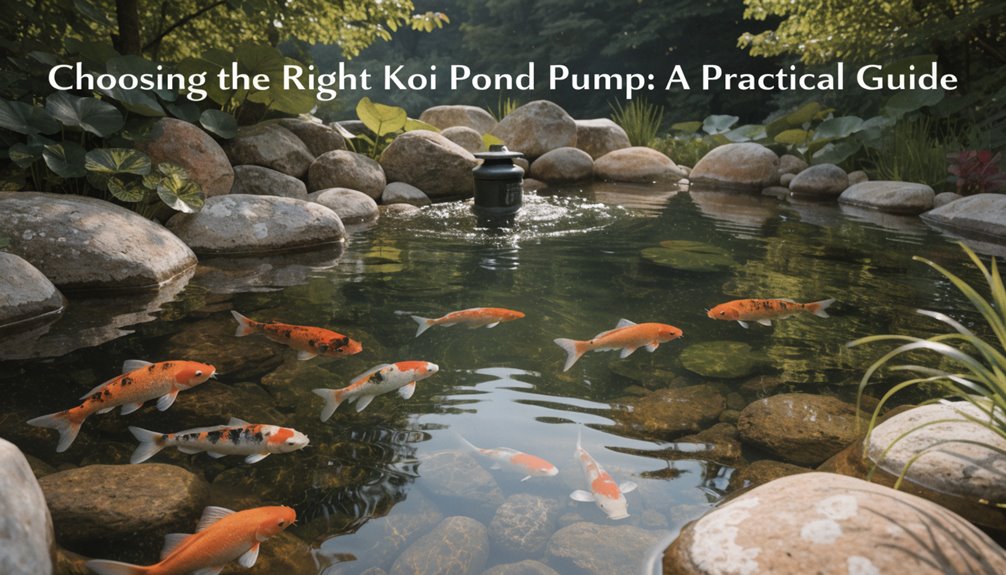
How do you choose the right pump for your koi pond? Start by considering your pond’s size, aiming for a pump that circulates 1-2 times the pond volume in gallons per hour (GPH).
For ponds over 1,000 gallons, external pumps are preferable due to superior efficiency and easier maintenance access.
Carefully evaluate pump head height and flow rate using manufacturer charts to ensure it meets your filtration system and waterfall requirements.
Energy-efficient motors, especially variable speed models, can cut electricity costs significantly.
Finally, match the pump’s capacity to your pond’s features and filtration setup to maintain optimal water clarity and koi health. Pattern quality is crucial for ensuring a thriving aquatic environment without wasting energy.
Precision in selecting these specifications ensures reliable circulation and supports a thriving aquatic environment without wasting energy.
Why Pond Pump Flow Rate and Pond Volume Matter for Koi Ponds
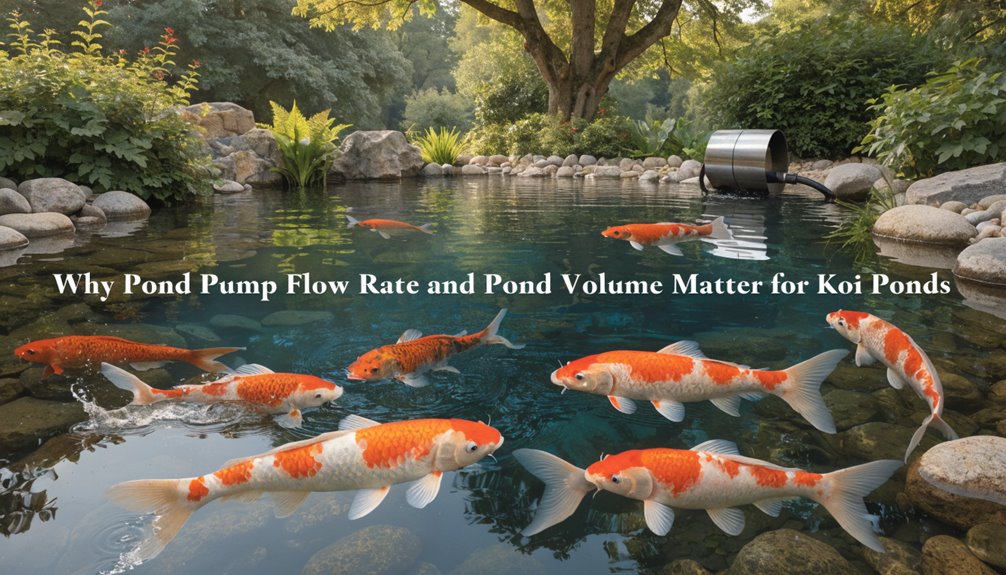
Because maintaining proper water circulation is crucial for koi health, matching your pond pump’s flow rate to the pond volume is essential.
The ideal flow rate typically ranges from 1 to 2 times your pond’s volume per hour. For example, a 10,000-gallon pond requires a pump delivering 10,000 to 20,000 gallons per hour (GPH) to ensure optimal filtration and oxygenation.
Selecting a pump with an inappropriate flow rate—either too high or too low—can cause poor water quality, stagnation, or excessive energy use.
By calculating your pond’s volume and desired turnover rate, you can choose a pump that effectively removes debris, maintains oxygen levels, and sustains a balanced ecosystem. This precise matching supports the health of your koi and aquatic plants, as a balanced ecosystem is vital for their longevity.
What Is Total Dynamic Head (TDH) and Why It Matters for Your Pump
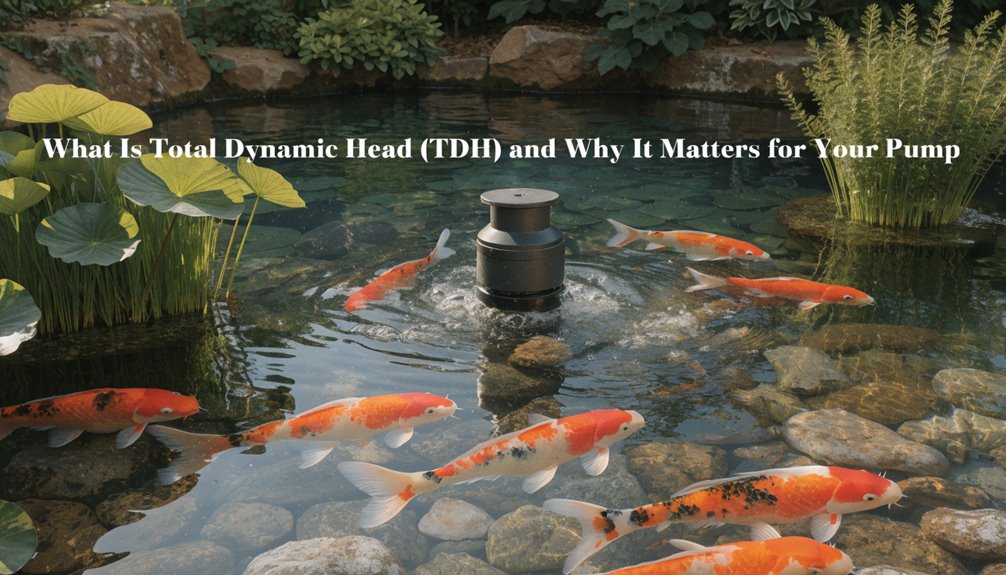
Why does Total Dynamic Head (TDH) play a critical role in selecting the right pond pump? TDH represents the total vertical and horizontal resistance your pump must overcome to circulate water effectively. It accounts for pipe friction, fittings, elevation changes, and the height of waterfalls or filters connected to your system.
Accurately calculating TDH ensures your pump delivers the required flow rate at the necessary pressure. Selecting a pump with an inadequate TDH rating reduces water movement, causing poor circulation or system failure.
Moreover, pumps working against higher head consume more electricity and wear out faster, impacting energy efficiency and longevity. Understanding TDH helps you choose a pump that matches your pond’s specific resistance, optimizing performance and durability. Additionally, using accurate volume measurements is essential for determining the correct pump size and ensuring effective water movement in your koi pond.
External vs. Submersible Koi Pond Pumps: Which Is Best?
When choosing a pump for your koi pond, you’ll need to decide between external and submersible models, each offering distinct advantages depending on your pond’s size and setup. External pumps excel in energy efficiency and durability, ideal for ponds over 1,000 gallons. Submersible pumps operate quietly and are easier to install, suitable for smaller ponds. Additionally, ensuring your pump is compatible with high-quality koi food can help maintain optimal water quality for your fish.
| Feature | External Pump | Submersible Pump |
|---|---|---|
| Location | Outside pond with pre-strainer | Inside pond or skimmer |
| Energy Efficiency | Higher | Moderate |
| Noise Level | Moderate | Low |
| Suitability | Large ponds (>1,000 gallons) | Small to medium ponds |
Choose based on your pond’s volume, noise tolerance, and installation ease.
How to Size Your Pond Pump Based on Turnover Rate and GPH
Selecting between an external and submersible pump is only part of ensuring optimal pond circulation. To size your pond pump correctly, focus on your pond’s volume and desired turnover rate.
Ideally, you want to circulate the entire pond water once to twice per hour. For example, a 3,000-gallon pond requires a pump delivering 3,000 to 6,000 GPH.
Calculate your needed flow rate by dividing the pond volume by turnover time (e.g., 3,000 gallons ÷ 1 hour = 3,000 GPH).
If your pond includes features like waterfalls or has significant head height, select a pump with extra capacity to counteract head loss.
Always choose a pump with a slightly higher GPH than calculated to offset system inefficiencies and allow for future expansion. Additionally, maintaining good water quality is essential for koi health and can influence the effectiveness of your pump system.
Top Energy-Efficient External Pumps for Large Koi Ponds
Although external pumps come in various sizes and capacities, choosing an energy-efficient model tailored to your large koi pond’s specific needs is crucial for optimal performance and cost savings.
For flow rates between 1,800 to 7,200 GPH, the PerformancePro Cascade Low RPM pump minimizes energy use with its low-speed motor, reducing wear.
If you require around 4,000 GPH, the Sequence Power 4000 Series employs advanced fan-cooled technology for superior efficiency.
For high head applications, such as ponds with waterfalls or elevated filtration, the EX13200 delivers up to 13,200 GPH while maintaining energy-conscious operation.
External pumps outperform submersibles in efficiency, maintenance, and longevity.
To maximize benefits, install these pumps with protective pre-strainers in dry, ventilated locations to preserve motor life and sustain optimal output.
Best Budget-Friendly External Koi Pond Pumps That Deliver Value
If you’re managing a smaller to medium-sized koi pond on a budget, you don’t have to sacrifice performance or reliability. Budget-friendly external pumps like the Anjon Landshark, priced around $355, deliver efficient flow rates suitable for typical pond setups.
Models such as EasyPro EXP4000 and EXP6500HP offer high flow capacities—up to 6,500 GPH—at accessible price points. Look for pumps with self-priming features and high head capabilities to support waterfalls, skimmers, and biological filtration.
While these pumps may have shorter lifespans than premium options, selecting reputable brands with warranties of three years or more ensures durability and value. Prioritize energy-efficient models to minimize operating costs during continuous use, balancing initial investment with long-term savings effectively.
Premium External Pumps for Complex or Large Koi Pond Systems
When managing large or complex koi pond systems, you need premium external pumps that deliver high flow rates and reliable continuous operation. Models like the PerformancePro Cascade High RPM and Sequence Power 4000 Series provide flows up to 8,800 and 13,200 GPH, perfect for ponds over 1,000 gallons with advanced filtration or waterfall features. Their durable construction minimizes heat and energy use, extending lifespan and lowering costs despite initial prices of $1,300 to $1,900+.
| Pump Model | Max Flow Rate (GPH) | Warranty |
|---|---|---|
| PerformancePro Cascade RPM | 8,800 | 3 years |
| Sequence Power 4000 Series | 13,200 | 5 years |
| Typical Price Range | $1,300 – $1,900+ | – |
These pumps ensure dependable, efficient performance in demanding environments.
Top Variable Speed Koi Pond Pumps for Precise Flow Control
Premium external pumps provide powerful flow rates for large koi ponds, but variable speed pumps offer the control needed for precise water management. Models like the Air Aqua FlowFriend and EasyPro VSP165 deliver adjustable flow rates up to 8,000 GPH, letting you tailor circulation exactly to your pond’s requirements.
These pumps use efficient DC motors ranging from 50 to 520 watts, minimizing energy consumption while maximizing performance. Integrated electronic controllers provide smooth, continuous flow adjustments, optimizing filtration, aeration, and water feature operation.
This flexibility not only enhances pond health but also reduces energy costs and prolongs pump lifespan. Many premium variable speed pumps include smart features such as remote control and automation compatibility, plus warranties typically spanning two years, ensuring reliable, precise flow control tailored to complex koi pond systems.
Variable Speed Submersible Pumps for Koi Ponds
Although managing water flow in koi ponds can be complex, variable speed submersible pumps like the EasyPro VSP165N and VSP270N give you precise control over circulation rates up to 5,700 and 8,000 GPH respectively.
These pumps operate within a power range of 60 to 480 watts and feature external controllers, enabling you to finely tune flow rates according to your pond’s specific needs.
Their energy-efficient design reduces power consumption by adjusting speed based on demand, delivering long-term savings.
Constructed with durable, corrosion-resistant materials, they withstand harsh aquatic environments.
Additional smart features such as automatic shut-off and frost monitoring enhance reliability and lifespan.
If you require consistent circulation paired with energy efficiency and precise flow regulation, variable speed submersible pumps offer an optimal, technically sound solution for your koi pond management.
Reliable Submersible Pumps for Small to Medium Koi Ponds
Variable speed submersible pumps provide excellent control and efficiency for koi ponds, but smaller setups often require reliable, straightforward solutions that balance performance and cost.
For small to medium koi ponds, consider the OASE AquaMax Eco Expert series, offering flow rates from 4,000 to 12,500 GPH and up to a 5-year warranty, ensuring durability and adequate circulation.
Alternatively, Anjon Monsoon pumps deliver capacities between 2,000 and 8,000 GPH with higher wattages, making them a budget-friendly yet dependable choice.
Quiet models like EcoWave and AquaSurge simplify installation while maintaining efficient water movement.
To optimize pump performance, select one that circulates your pond’s total volume at least once per hour.
Remember to perform regular maintenance, including cleaning intake screens and inspecting impellers, to maximize pump longevity and efficiency.
Essential Accessories: Pre-Strainers and Leaf Traps to Protect Your Pump
When you protect your pump with properly installed pre-strainers and leaf traps, you significantly reduce the risk of debris-induced damage.
Pre-strainers filter out leaves, twigs, and large particles before they enter the pump, preventing clogging and minimizing maintenance.
Leaf traps, typically placed inline with external pumps, offer easy access for routine cleaning and ensure consistent water flow.
Using high-quality pre-strainers and leaf traps extends your pump’s lifespan by protecting critical components from debris buildup.
Regular maintenance of these accessories not only prevents pump failure but also enhances overall pond system efficiency.
How Using Two Pumps Boosts Koi Pond Safety and Performance
Protecting your pump from debris with pre-strainers and leaf traps is a key step, but ensuring uninterrupted water circulation requires more than just filtration safeguards. Using two pumps in your koi pond provides continuous flow even if one fails, preventing stagnation and oxygen depletion.
Operating dual pumps at lower speeds not only boosts energy efficiency but also extends pump lifespan compared to a single high-capacity unit. Splitting flow between two pumps offers redundancy, maintaining essential filtration and aeration during maintenance or breakdowns.
Additionally, dual pumps allow precise control over different pond zones or features, enhancing water quality and koi health. This setup significantly improves pond safety by ensuring backup water movement and oxygenation during power outages or pump malfunctions, safeguarding your aquatic environment effectively.
Maintenance Tips to Extend Your Koi Pond Pump’s Lifespan
Although koi pond pumps are designed for continuous operation, regular maintenance is crucial to maximize their lifespan and reliability. You should clean pump intakes, filters, and pre-strainers regularly to prevent debris buildup that can cause overheating or clogging. Monthly inspections help identify wear early, ensuring optimal performance. Always use manufacturer-recommended cleaning methods, avoiding harsh chemicals that can damage components. Promptly replace worn parts and maintain balanced pond conditions to reduce pump strain.
| Maintenance Task | Frequency | Key Benefit |
|---|---|---|
| Clean intakes & filters | Weekly | Prevents clogs, overheating |
| Inspect pump components | Monthly | Detects wear, prevents failure |
| Use proper cleaning | Per manufacturer | Protects pump materials |
| Replace worn parts | As needed | Ensures durability |
How Energy Efficiency Impacts Long-Term Pond Pump Costs
Because pond pumps run continuously to maintain water quality and circulation, their energy efficiency directly affects your long-term operating costs. Energy-efficient models with advanced motor technology and variable-speed controls adjust power demand dynamically, reducing electricity consumption by up to 60%.
Over three years, choosing a higher-priced, energy-efficient pump—around $600—can save you approximately $280 in electricity compared to less efficient alternatives. These pumps also tend to have longer lifespans and lower maintenance requirements, enhancing overall value and system reliability.
Given the necessity of continuous operation, prioritizing energy efficiency minimizes ongoing costs while supporting pond health. Investing in a high-efficiency pump ensures optimal performance, cost savings, and durability, making it a prudent choice for maintaining your koi pond effectively and economically over time.
Warranty and Support: Choosing Koi Pond Pump Brands That Stand Behind Their Products
When selecting a koi pond pump, you should prioritize brands that back their products with robust warranties and reliable support. Reputable manufacturers like OASE, PerformancePro, and Aquascape offer warranties ranging from three to five years, reflecting confidence in product durability and reliability.
Extended coverage, such as OASE’s five-year warranty, reduces long-term risk and signals strong customer commitment. Additionally, many brands provide replacement policies and accessible support services to address premature failures, minimizing downtime and maintenance issues.
Choosing pumps from well-established companies with positive user reviews ensures readily available parts and technical assistance. This approach not only safeguards your investment but also enhances operational continuity, making warranty and support critical factors when comparing koi pond pumps.
Frequently Asked Questions
What Size Air Pump Do I Need for My Koi Pond?
You’ll need an air pump delivering about 1 CFM per 100 gallons of water. For a 1,000-gallon koi pond, choose a pump rated around 10 CFM, ensuring it supports your aeration devices efficiently and quietly.
Who Makes the Best Pond Pumps?
You’ll find that pumps from Aquascape and PerformancePro boast over 90% reliability rates due to advanced engineering. They deliver efficient flow and durability, ensuring your koi pond’s ecosystem thrives with minimal maintenance and excellent energy use.
What Size Pump Do I Need for a Koi Pond?
You’ll need a pump rated slightly above your pond’s volume per hour—around 20-30% higher—to ensure optimal filtration and oxygenation. Factor in additional head height from features like waterfalls for accurate sizing and efficient circulation.
What Is the Most Reliable Water Pump Brand?
You’ll find Aquascape the most reliable water pump brand, thanks to their durable construction, excellent warranty, and strong customer support. Investing in their pumps ensures longevity, consistent performance, and readily available replacement parts for your koi pond.
Conclusion
Choosing the right koi pond pump isn’t just about power; it’s about precision and reliability. While a high flow rate ensures cleanliness, ignoring Total Dynamic Head risks inefficiency. External pumps offer easy access, yet submersible models provide discreet operation. Balancing turnover rates with energy efficiency saves costs but demands smart sizing. Using two pumps may seem complex but significantly enhances safety. Ultimately, your choice reflects a careful trade-off between performance and long-term durability.

